Free for All Watch, Week 2: Feeling Groovy

I get results!

Just one week after launching my Free for All Watch, dissecting the many gripes of the Washington Post‘s Grumpy Old Man page, the public has spoken. Or typed.

This week, Oct. 18, there were three — count them, three! — positive letters for the paper, an unheard of level of generosity in the two weeks I’ve been officially taking note. One letter saluting Michel Du Cille for his photograph, another lauding a front page map, and a third thanking writer Martin Weill for his light-hearted zoo story.

Now that’s three out of 13 letters, but this could be a trend. Or, to phrase it in current headline-writing fashion: Could this be a trend? (See also Twitter’s SavedYouAClick for a welcome antidote for such link-bait question-mark headlines.)

scott butterworth retweet

And speaking of Twitter, Post editorial page editor Scott Butterworth re-tweeted my inaugural Free for All Watch column, which I am taking as proof positive that my brave work is finally being heeded. While the editors did not choose to run any letter similar to the one I predicted would appear (and really, how could they?), I remain convinced that I am the power behind this week’s outpouring of love and good will for D.C.’s paper of record.

You’re welcome.

Washington Post Free For All Watch

My Saturday morning breakfast ritual is to turn to the Free for All page in the back of the A section of the Washington Post and fill up on righteous indignation along with my English muffins. Free for All is an entire newspaper page devoted to letters to the editor, almost all of them ranting about the many failures of the daily paper. I call it the Grumpy Old Man page, though women are equally represented among the aggrieved.

As a grumpy old man, my name has appeared on the Free For All page with sad regularity. I rose to defend the honor of Alfred E Neuman, nit-picked sloppy illustration for a design story in the Local Living section, and complained about bicycle regulations, among other vitally important issues. That level of pedantry is not out of place on Free for All. Basically, the editors are damned if they do and damned if they don’t on any and every topic.

Thus, I am something of an expert at spotting what will get a rise out of Post readers. One of the most common types of Free for All letter is the complaint about what does or doesn’t appear on A1. In this inaugural post for the series, I will predict next week’s Free for All. You will surely be reading something along the lines of this:

Dear Editor,

What possessed you to waste precious space on the front page of the newspaper with what is for all intents and purposes an advertisement for a Hollywood movie? [“For real-life Alexander, the days are pretty good,” A1, Oct. 11.] Even to the point of using not one but two stills from the film as illustration!

How very nice for Alexander Viorst that his mother wrote a book about him (Alexander and the Terrible, Horrible, No Good, Very Bad Day), and that it has now been turned into a big-budget Steve Carell movie. But such stories, if they must appear at all, should be relegated to the Style section and not the front page of what used to be a great national newspaper.

Grumpy Old Man, Silver Spring

P.S.: You also misspelled the name of the movie’s co-star. It is Jennifer Garner, not Gardner. She is the wife of Ben Affleck, Mrs. Batman, for heaven’s sake!

Rock & Roll Will Never Die — If The Fabulous Hubcaps Have Anything To Say About It.

hubcaps washington post

My piece on the Fabulous Hubcaps takes over most of the front page of the Washington Post Style section today. The assignment called for 1,200 words. I wound up with nearly 13,000 transcribed words. So I think I undersold the piece. Coulda been a magazine feature, ’cause there was sooo much fascinating, fun, and relevant info that did not make the cut. I will say that I’m glad to be able to use the serial comma again. Also, when will publications stop putting a K in the abbreviation of microphone? It’s mic, not mike. Mike is a person.

But these are personal peeves and not aimed at any of the fine staffers and friends at the Post. Go, newspapers!

Here Today, Gone Tomorrow

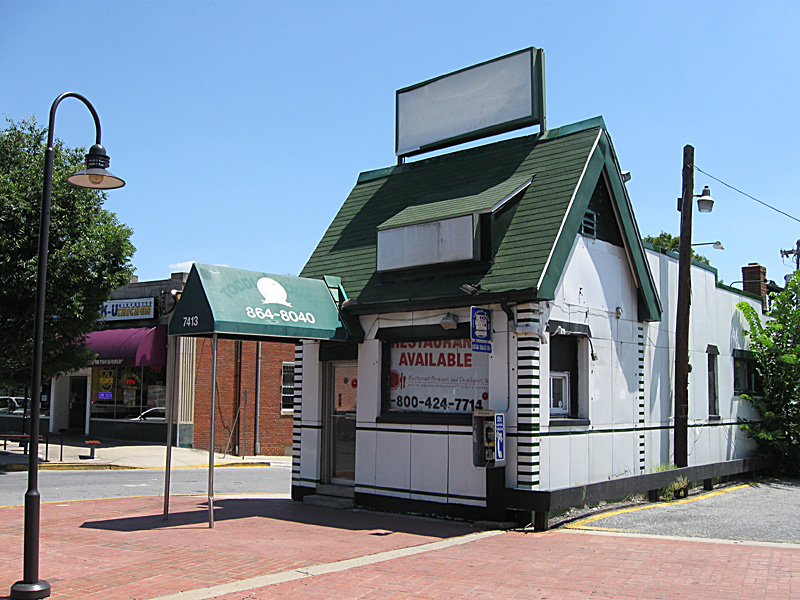
Above is a photo I took last week of one the last remaining Little Tavern buildings. Like most of the rest of the chain, it had been turned into something else, in this case a Chinese carryout, Golden House. (I have placed orders there on more than one occasion. Not bad.) My plan was to snap pictures of what few remaining LTs existed so that I could post them on the article I wrote about the fabled D.C. diners.

Below is a picture I took today. I have no explanation, other than the new X-Files movie just opened.

(Originally posted July 28, 2008.)

Deathball 2009: The Return of Little Tavern

I’d been meaning to go to Laurel to see if its Little Tavern Shop was still standing and snap a pic if it was. The Laurel location was the last operating restaurant in the once-proud chain, and one that I had never been to. (Shame on me, I know.) I’ve posted my previous LT articles here and here, and planned to add fresh images.

So imagine my surprise to find that not only is the building still standing, but you can get a burger. All praise Harry Duncan!

So many of the old locations have become takeout spots, been repainted, expanded, and otherwise mashed into the landscape. The Maryland Historical Trust put this shop on its registry (“an excellent example of mid-twentieth century roadside commercial architecture”), an honor not accorded similar outlets in D.C. While it was initially alarming to see the big “DONUTS” marquee, kudos to the signmaker for reworking the original Little Tavern typography into the new Laurel Tavern.

Inside, the place seems even more crowded than the old shops were. The stools and counter have been replaced by a glass case filled with donuts. And the grill has been replaced with donut-making machines, looking as vintage as the building and coated with sugar. I should have asked if the new owner acquired the equipment from the old Krispee Kreme on Rt. 1 in Alexandria. That would be fitting.

A small hand-written piece of paper taped to the side window proclaims “We have Burgers!!” I dared not dream it was true, and so first ordered a glazed, which looked fresh and was. If a Little Tavern has to be replaced, fresh donuts is not a bad option.

When I asked if they actually made the old-style hamburgers, owner Jin Kwon said, “Small ones. Yes. I just make these,” and opened a heating tray. She pulled out a three-pack, a trio of tiny burgers stuck together. Apparently, there’s a deal if you buy ’em that way. Not quite the bygone bagful, but enough for breakfast today.

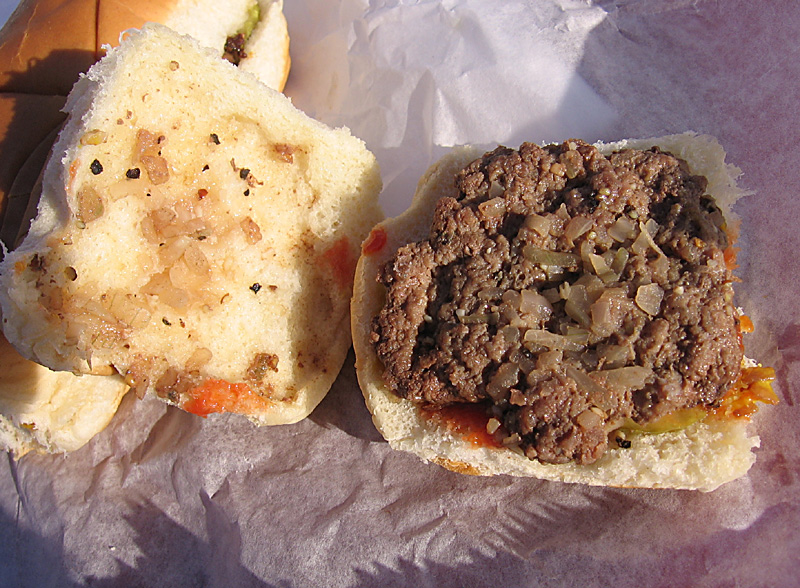
So…how do these 21st century models stack up to the Deathballs of yore? Well, they’re small (good), damp from the warming drawer (good), covered in greasy chopped onions (good). Asked if I wanted ketchup and mustard (of course!), Kwon applied same from separate yellow and red bottles. The single mutsup/catard concoction was a model of efficiency in the old days, but once it all mixed together the effect was the same.

The first bite was truly nostalgic nirvana. But — the beef is too spicy. Pepper, I think. Which is to say, there is spice where the old meat was just gray. Not unpleasant, but not what I was expecting.

Still, they warmed me up all the way back to Silver Spring. And, in that patented Little Tavern way, I can taste ’em still.

Ironically, the Laurel shop is across the street from the Laurel Tastee Diner, which is the only Tastee location I haven’t been to. Guess I gotta start spending more time in Laurel…

Here’s a Gazette article about the Laurel LT’s return from about a year ago. And here’s an account from a diner blog.

Death for the Deathball?

The area’s last Little Tavern may not make it to the millennium.

little tavern

The sign reads “Lease or Build to Suit.” No big deal on a fast-changing corner in suburban Maryland. Unless, that is, you like your burgers greasy, cheesy, and little. That’s because this ominous notice of real estate transition hangs from the last Little Tavern near D.C., an outpost on busy Viers Mill Road in Wheaton. Has the eatery that has stood for decades along the suburb’s original commercial district slung its last greaseball?

Inside, Tony the cook dismisses the huge banner with a laconic “Just negotiating the lease, just scare tactics.” His full attention is turned to starting a run of the large-sized burgers. But if you turn your gaze past Tony and out the window, you’ll see that what until very recently was a half-block of low-rent office buildings is now rubble—bulldozed, the cook says, to extend a parking lot. The rubble heralds a future much friendlier to T.G.I. Friday’s than to the venerable local burger joint.

Up and down Viers Mill Road and Georgia Avenue, the ‘burb that was once described as “a funky ethnic enclave” is in danger of defunkifying. Wheaton Plaza is planning an expansive “revitalization.” Not long ago, a bright new car dealership went up across from the aging Little Tavern, which still boasts a Ms. Pac-Man in one corner and a Street Fighter II machine by the door.

Defunkification is also a pretty good way to describe what’s happened to the rest of the region’s string of Little Taverns. What had once been a mighty chain of more than 50 locations had dwindled to fewer than five when former Tavern employee Al Wroy bought the business in 1992 (“Places That Are Gone,” 11/10/95). Although a new tavern opened in Ocean City this summer, and there are two shops remaining in Baltimore and one in Laurel, the Wheaton shop is the last option for most D.C. epicureans in search of distinctive dining.

Wroy won’t say much about the sign that obstructs half of his view. “That’s just standard,” he says. “They will put a sign up on your building to force you to come to the table on their terms. It’s just a standard thing that landlords do.”

But he won’t comment further about his last local franchise’s future. “When you’re in negotiations, you don’t say anything about it,” Wroy explains softly over the phone. “I don’t own the property, the landlady has sold the property, and the new owners…I feel they have other plans for the property, but I really can’t tell you what. They always try to make you feel like they have other tenants for the property.”

“I wish I could answer you more,” says the understanding Wroy. The landlord’s real estate agent did not return a phone call by press time.

Sitting at the Wheaton restaurant’s empty counter, manager Cynthia Johnson Brown isn’t talking about Little Tavern’s birth way back in 1928, or about how Arthur Godfrey used to pitch its burgers on the radio, or about the “Buy ‘Em by the Bag” slogan that was the chain’s claim to fame.

Maybe that’s because Brown is spending a weekend afternoon watching cars drive up and down the hill outside, toward Rockville or Silver Spring—or to the Shoney’s up the block. Shoney’s just went 24-hour, adding competition in what had been Little Tavern’s exclusive niche. “To make a long story short, we would like for more people to come visit us,” says Brown. “I’m trying to save a part of our history. I need all the customers I can get my hands on. And then some.”

With Godfrey’s ads long gone from the airwaves, Brown appears to be Little Tavern’s only weapon against an endless stream of competing burger advertisements. This afternoon, she’s giving Ronald McDonald and Dave Thomas a run for their PR money.

“It’s still a family place,” Brown announces. “I get a lot of couples, this is where they met. Right here in this Tavern. There’s this one man—I don’t know his name, but I know him by face. And he said he remembered when they built this. And he’s like 86, 87 years old. He comes in, gets two burgers, nothing but onions only. Last time I saw him was last year—I thought he might have expired. But he came in last week. And I was really glad to see him. I was really glad to see him. He said he was under the weather and all that. But he came in, ‘Got to have my two—onions!’ He said, ‘You still here?’ I said, ‘You still here?'”

“And then this one man who had had open-heart surgery…” Brown adds. “Believe it or not, this is where his wife had brought him, because he really had a taste for it. She said, ‘If that’s what it takes…’ and he came twice. And that made me feel good, so I made him a little something special. I threw in a few extra burgers. He don’t get out of the car, but he’s like this—thumbs up!—so everybody was happy.”

Brown agrees with me that Little Tavern hamburgers are the best in the world.

little tavern

“Yes they are. Yes, they are. You can’t beat ’em. You cannot really beat ’em. And one thing, over 30 years and still—fresh meat. Our meat is not frozen. You’re getting fresh meat. We’re giving you the best service we can. We hand-roll our patties, our balls. We’re still the old-fashioned way.”

The old-fashioned way is quickly becoming older-fashioned: Soon we will be referring to recent events as occurring “in the last century.” But perhaps history can save the Wheaton Little Tavern. Brown suggests that her shop has been submitted for landmark status. But a call to Gwen Wright, historic preservation coordinator for Montgomery County, proves this statement wrong.

“The Wheaton Little Tavern has never been evaluated for historic preservation status,” says Wright. Four Tavern structures in the county were looked at in the early ’90s. The Bethesda location, now a Chinese carryout, got the nod.

“My sense is—although I don’t really know this—my sense is that the County Council that designates, that makes the final decision, it was a little bit of a leap of faith for them to designate the Little Tavern, so they said, ‘We’ll do one,’ and it was the one in Bethesda,” says Wright, adding, “The one in Wheaton was never brought up.”

A glance at the Montgomery County Code suggests that the last Little Tavern might be a shoo-in if anyone were to nominate it. The code has nine criteria for determining a structure or area to be historic. Among them is whether the site “is identified with a person or a group of persons who influenced society.” Of course, Little Tavern is the country’s second-oldest restaurant chain, after White Castle. Founder Harry F. Duncan once claimed to have invented the cheeseburger. Consider the history of America without the cheeseburger.

Another criterion is whether the building “embodies the distinctive characteristics of a type, period, or method of construction.” The application for the Bethesda Little Tavern, built in 1939, makes much of the “symbolic nature of the design,” noting that “all of the Little Tavern Shops were built in a style reminiscent of an Old English tavern as a way of conveying a pleasant, familiar environment. However, in order to evoke the notions of speed and efficiency associated with fast, inexpensive meals, the design utilized the newer technology and materials of the ‘moderne’ era—neon lighting, tile, formica, metal alloys, and vitrolite.”

Do Starbucks use vitrolite?

And according to the regulations, a site may become historic if it “represents the work of a master” [pass] or “possesses high artistic values” [pass]. Also, if it “represents a significant and distinguishable entity whose components may lack individual distinction; or represents an established and familiar visual feature of the neighborhood, community, or county due to its singular physical characteristics or landscape.”

Well, Wheaton without Little Tavern would be like D.C. without baseball or congressional representation. Or, er, uh…

Anyone may nominate the Tavern for landmark status, says Wright. “That would mean filling out the appropriate forms and submitting them to the county. And certainly that could happen. I think I had a call last week from someone with historic preservation in Silver Spring, asking about the process regarding the Wheaton Little Tavern.”

“But just because it’s designated doesn’t mean that it will stay a Little Tavern,” Wright warns. “Historic designation does not control use—it just controls the facade. Historic designation cannot force a landlord to grant the existing current Little Tavern a lease. It could be designated historic and still become a Chinese restaurant.”

Coincidentally, the day after speaking with Brown, I run into Montgomery County Executive Douglas Duncan at one of those typical MoCo dedication ceremonies. I ambush him with questions about the Little Tavern, pointing out that Silver Spring’s Tastee Diner was saved from the wrecking ball. There is a proud county history of supporting good bad food.

Duncan—no relation to the chain’s founder—chuckles and says he’ll look into it.

Back in Wheaton, Brown smiles and shakes her head. “For all the old customers, or the ones who don’t believe we still exist, we’re here, we’re here—11143 Viers Mill Road. Please come and visit. Please come and visit.” CP

(See also: Places That Are Gone: Remembering Little Tavern Restaurants, D.C.

Places That Are Gone

Remembering Little Tavern Restaurants, D.C.’s Greasiest Greasy Spoons

little tavern

Club LT. The LT Lounge. Deathballs.

In 1928, Little Taverns began springing up on the Washington landscape like pimples at a Lisa Loeb concert. With their steep-pitched, green-tiled roofs, the restaurants resembled miniature Swiss chalets—or very large cuckoo clocks. Inside, a greasy grill and maybe a dozen stools invited customers to partake of a menu that was Henry Ford basic: any food you want as long as it’s a hamburger. By the mid-’40s, there were 50 Little Taverns, and Arthur Godfrey pitched their charms on the radio.

Today, D.C. diners in search of a high-fat diet have exactly one choice: The last tavern sits on a sloping lot in the

The Song Remains Inane

Novelty music is still silly, stoopid, and weird—which is exactly why the Top 40 could use more of it.

THE SMALL THINGS DISAPPEAR FIRST, and in their absence the future is revealed. You’re downloading yesterday’s My Name Is Earl onto your U2-branded iPod, say, when suddenly your digital reverie is interrupted by a realization: Something’s missing.

Where in this always-on, P2P, wirelessly instant-messaged existence is that great Harry Potter parody song? Or even a lousy one? Where, come to think of it, are the musical mockeries of Mariah, Fiddy, and Jeezy? Did we all forget to add “novelty tunes” to the RSS feed? That Chronic

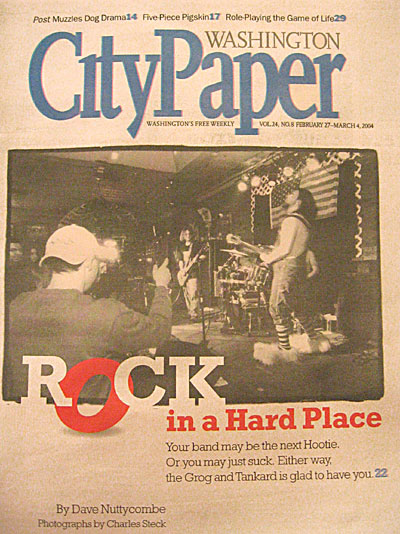
Rock in a Hard Place

Rock ‘n’ roll on the friends-and-family plan

ONE SATURDAY AT AROUND 7 P.M., Colin Hoss is at his bar, the Grog and Tankard. The joint is open for business, but the club is nearly empty as the 36-year-old Hoss steps into a tiny sound booth for a quick double-check of the equipment. In a couple of hours, a band you never heard of will be jumping and sweating and shouting on the wooden stage sticking halfway into the middle of the rectangular room. It wouldn’t do for the eardrum-shattering sound to cut out while the kids are standing around not dancing.

Whoever walks in the Grog’s door later that night will not have read about the show in the Washington Post. Or the Washington City Paper. In the next day’s paper, there’ll be no reviews of the show, no mention of the deer head on the wall, the big cloth butterfly floating over the pool tables, the sweating rock fans crowded into a narrow, smoky room. Word of the performance will have leaked out only through the primitive channels that seem appropriate for the Grog’s throwback look: People will have heard about it from their friends, who will maybe have friends in the band, which will have sent out an e-mail. Maybe the audience will be mostly family.

They’re certainly not the usual “North Georgetown” yuppies who ply the strip of Wisconsin Avenue on which the Grog has squatted for 40 years–the folks who chew upscale pizza at Faccia Luna Trattoria or down margaritas at the Austin Grill next door. And they’re probably not regular patrons of the adjacent strip club, JP’s.

No, the scene at the Grog is its own little bluejeaned world in the middle of pressed-khaki Glover Park, a world that changes ever so slightly from one night to the next, depending on which band has coaxed enough of its mailing list to the show.

The club’s Web site makes much of the fact that there is no built-in audience. Every band must bring its own crowd. Phishy jamheads one Wednesday, aggressive rap-metalers on Thursday, bluesy roots-rockers the next Friday, power-poppers on Saturday.

The Grog draws largely from the nearby colleges: American University, George Washington, Georgetown. Unlike the moody dreamers and self-defined outcasts who populate the Black Cat, Velvet Lounge, or Galaxy Hut, a Grog crowd usually looks to heavily represent the pre-law, pre-med, pre-middle-management aesthetic.

And the Grog has perfected a business plan for catering to that demo. Family entrepreneurs in the time-honored American tradition, the Hossainkhail brothers left Afghanistan to come to, as Colin says, “the greatest country in the world called U.S.A.,” when Colin was about 14. After acquiring the Brit-pub-style club from Englishman Nicky Williams in 1984, the Hossainkhails grafted the same name onto a second club, in Baltimore. The chain grew to include another Baltimore venue and Planet Nova in Virginia. Now the family concentrates on the D.C. Grog. Oldest brother Abdul handles the day-to-day operations, as well as dealing with the D.C. bureaucracy over permits and the like. Middle brother Hammed watches the door. And Colin, n