Whose American Theater Is It, Anyway?

THE FALL THEATER SEASON IS getting started, playbills are coming back from the printers, and dozens of local playhouses are promoting their upcoming slate of “theatre.” This raises the question: Why can’t American thespians spell?

Search the American Theater Web, which should be some kind of authority on the subject, and the Anglicized style takes an almost 2-to-1 lead over the hometown kid. Sadly, the more local you get, the less American the theatrics. The roster of the League of Washington Theatres—which notes its allegiance in its name—offers a nearly 5-to-1 ratio of D.C. “theatres” to D.C. “theaters”: Studio Theatre, Signature Theatre, Source Theatre, Round House Theatre, Actors Theatre of Washington, African Continuum Theatre Company, Charter Theatre, Little Theatre of Alexandria, Theatre Alliance, Theatre J, Trumpet Vine Theatre Company, Young Playwrights Theatre, and on and on.

Even Pennsylvania Avenue’s National Theatre, which trumpets itself as “the Theatre of the Presidents,” refuses to call itself the National Theater.

Erin McKean, senior editor of U.S. dictionaries for the Oxford University Press and editor of Verbatim: The Language Quarterly, explains that Noah Webster, in his 1828 American Dictionary of the English Language, juggled the “-re” into “-er” to standardize the word “theater.” This was part of his longstanding quest to wrest control of the native language from the dictionary of notorious American-hater Samuel Johnson. Henceforth, Yankees were free of the time-wasting encumbrance of extra letters in “traveller,” “waggon,” and “jeweller,” blessed with streamlined forms of “color,” “jail,” and “ax.”

“British is often assumed to mean ‘better,'” McKean writes via e-mail, “especially when it comes to cultural products—such as plays. So it’s not so much ‘putting on airs’ as it is ‘knowing their customers,’ who probably respond more favorably, if unconsciously, to ‘theatre.'”

Donn B. Murphy, president of the National Theatre and a professor emeritus at Georgetown University—which offers degrees in “theater,” though Murphy lists his field as “theatre”—is unashamed of his playhouse’s spelling habits. The place, he points out, dates from 1835, a mere seven years after Webster published his dictionary.

“I guess Mr. Webster’s fiat hadn’t been sufficiently circulated and popularized,” Murphy says. “Or perhaps the organizers of the National—including Mr. Corcoran of latterly Gallery fame—wanted to continue to be a bit more cosmopolitan or international in tone.”

Either way, D.C. drama supporters have kept rejecting Webster through the years. In 1863, John T. Ford named his little place on 10th Street Ford’s New Theatre. Joyce Patterson, spokesperson for Ford’s, is delighted to check the historical record: “I’m looking at the playbill, a re-creation of the ticket from the night President Lincoln…” Her voice trails off over the phone, even though it’s been 138 years. “We are following in the footsteps of Mr. Ford,” she offers. “I’m sure during that day or time they would have used the British spelling.”

Gail Beach, producer for the Hartke Theatre at the famed drama department of the Catholic University of America, notes that the spelling “goes through phases, and a bunch of theater groups in town were founded by people who came out of this department. So maybe it’s what they were raised with.”

Many proponents of the “theatre” spelling deny that they’re rejecting American spelling. They argue that “-re” relates to plays and “-er” is for movies.

Or they share the view of Ben Cameron, executive director of Theatre Communications Group, the industry association that publishes the New York-based American Theatre magazine. “Technically, ‘-er’ means the building and ‘-re’ means the process.” Hence his magazine spells the word with “-re” not only in its title, but in all uses of the word “theater” in its articles.

Says Oxford’s McKean, “This sounds like a distinction in search of a difference; people love to try to find logic behind word choices that are usually not logical at all. The only difference I am aware of is that ‘the process’ is often referred to as ‘the theater,’ as in ‘What made you want to go into the theater?'”

Cameron also points out that worrying about the spelling means that “half the theaters in America are un-American.” But he’s not bothered. “I think we look at it as classic American diversity.”

Others view it as classic theater-industry pretentiousness. Bruce Burk of the State Theatre in Falls Church says his venue’s owners “wanted to have more of the image of”—he lapses into an imitation of Jon Lovitz‘ Master Thespian character—”the thee-ahh-taaaah!”

Beach notes that when she began her theater career, “They wanted to make me the costumier. And I said, ‘No, costumer is fine. Forget all this effete stuff—that’s not a word we use in this country.’ It was a lot of extra letters that didn’t get me further in this job and didn’t pay me any more.”

The Anglicized spelling reflects “frontier insecurity about theatrical art,” says Jack Marshall, CEO and artistic director of the American Century Theater, which is “dedicated to great, important and neglected American plays and playwrights of the 20th century,” according to its red, white, and blue Web site.

Marshall thinks that the prevalence of “-re” is a recent phenomenon. “Back in the ’60s, when I was in college, I saw ‘-er’ more often. I guess somebody decided that ‘-re’ looked cooler on the page and gradually it became the more common standard. There are regions of the country where nobody uses the ‘-re’ form—the Midwest and the West.”

Perhaps there are, but searching an online database for Madison, Wis., theatrical venues finds 21 “theatres” to 15 “theaters,” including—Marshall may be sorry to learn—the “American Players Theatre.” In Nebraska there is Theatre West; Illinois has the Cadillac Palace Theatre, Indiana the Paramount Theatre. Then there are the Fargo Theatre in North Dakota, the State and Orpheum Historic Theatres in Minnesota, and the Ariel, Victoria, and Sandusky State Theatres in Ohio. Thank god for Wisconsin’s Pabst Theater.

Still, a few institutions reject the British spelling altogether. “The New York Times will only spell it ‘-er,'” says Cameron. After a recent story on the magazine, Cameron tried to shake the paper’s ironclad standard. “I went back to them and they said, ‘I’m sorry, our policy is to spell it “-er.”‘ I said, ‘You’re printing a typo of my organization in your paper,’ and they still wouldn’t do it.”

And some theaters have a right to their Anglophilia. It would be churlish to demand that the Shakespeare Theatre change its name. The Theater of the First Amendment, on the other hand, had no choice but to embrace Americanism. Or did it?

Managing Director Kevin Murray explains that when he and Artistic Director Rick Davis were hired at the end of the theater’s first season in 1991, “the previous theater director was using ‘-re.’ And the first thing Rick says was, ‘Theater’s spelled with an ‘-er’ in this country.’ And so, since we were still young, we went ahead and made that switch.”

“I grew up in this town surrounded by theaters that used ‘-re,'” Murray says. “But when you went to a theater, a venue, a room, it was often an ‘-er.’ Then a strange thing happened. I think movie theaters, drive-in theaters, everything started using ‘-re.’ It’s kinda like the ‘e’ on the end of ‘Olde Town.’ Some people think it adds class. I don’t think it necessarily does, but sometimes the sway is held by the vast majority out there.”

Also fighting against the vast sway is the American Century Theater. But that company, too, nearly used the 18th-century spelling, Marshall confesses. When Marshall and his partners originally set their mission to paper, they spelled the name with “-re.” “And my wife said, ‘That makes no sense whatsoever. Why would you ever use the British form of the word?'”

Marshall reveals that this all-American policy has had its costs.

“It’s opened the way to millions of misprints. On a regular basis, a printer will use the British form. We’ve had to throw out business cards.” Marshall even has to “harangue” board members for improper usage.

Marshall says that the order of the two little letters has “actually been something of a mission in and of itself, and a crusade. As often happens, you come by your passion accidentally, more by happenstance than intent.”

Compounding the difficulty of his crusade is the fact that the company performs in Theatre II at the Gunston Arts Center. “We’re carrying on our own rear-guard action here,” says Marshall.

But in the District, it seems to be a losing fight. Even among movie houses: PG Theatres, the new operator of the Avalon Theatre, opted to go Anglo when it reopened the facility. Why? PG owner Paul Sanchez is stumped by the question: “Why did we do that? I guess it was me. They let me do some of these major decisions.” The decision matches the company name, about which Sanchez passes the buck to his late business partner, who made the choice around 1970. “I said ‘OK, we’ll go with that. They both sound the same—what the hell.'”

Pondering, Sanchez comes up with another explanation: “One of the other reasons is my late partner liked to drink a lot. It might be one of those situations. Maybe he’d had a snoot-full. Maybe he picked up the dictionary and picked the wrong one.”

Reprinted from Washington City Paper
Special to the Washington Post, again

watchful eye by bradley stevens

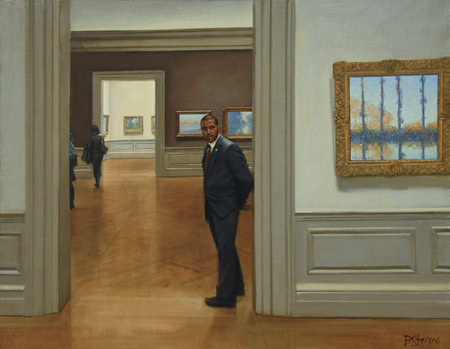
My profile of artist Bradley Stevens is in today’s Washington Post.

I was completely charmed by his paintings of the insides of various museums, many familiar but all having a sense of deja vu. I wanted to write about Stevens’ work because I felt it was the kind of serious-but-not-fashionable art that goes mostly unmentioned. For one thing, Stevens is a representational painter, a style that’s been losing credibility with critics since photography came along. But Stevens has been making his living with his brushes for a long time, and I felt that effort deserved some notice. I fully expected someone at the Post to pooh-pooh the idea. Perhaps the pooh-bahs weren’t looking.

There may be some unsold paintings from his “Museum Studies” series available at the charming Warm Springs Gallery in also-charming Charlottesville, Va. And, Brad has an upcoming show beginning April 10 at the Buchanan Partners Gallery, part of the Hylton Performing Arts Center in Manassas. While that show features other Stevens works, some of the “Museum Studies” works will be on display as well.

Hot Hot Hot

Passion: The Music of Love
Various Artists
Intersound

Passion: Music for Guitar
Various Artists
Narada Lotus

Romance: Music for Piano
Various Artists
Narada Lotus

THE CONCEPT OF MAKE-OUT MUSIC is probably as old as music itself. Surely Pythagoras developed his notion about the “Music of the Spheres” after a particularly hot toga party. Beats there a modern heart so cold that it can’t be turned to mush at the first strains of some radio hit from the puberty years? The song that first stirred your loins may be embarrassing twaddle in the full light of maturity, but that’s beside the point. The point is, music hath many charms, one of which is to fan the flames of desire.

The average 45 rpm record lasts barely three minutes. Granted, that’s longer than most anxious teen-age males need, but it’s still problematic. The old long-playing vinyl album was only good for 20 minutes, at most, before someone had to get up and replace the tone-arm. But with the advent of compact disc technology, modern swingles can program hours and hours of sensual sounds for uninterrupted rapture. For the multi-orgasmic and slow-to-ignite, this would seem a near necessity.

After the mad vault-cleaning rush of best-ofs and box sets, enterprising record companies have realized they can target acquisitive consumers with theme releases. And since nothing sells like sex, it’s hardly surprising that a near glut of prepackaged boudoir soundtracks should appear. In addition to the discs here, Cyborgasm 2 is out, and Rhino will shortly release Smooth Grooves: A Sensual Collection, four volumes of “Quiet Storm” music.

The discs at hand contain no triple-X, Donna Summer “Love to Love You Baby”-style explicitness. Rather, they take a Hallmark-card approach, with the packaging including many poems to set the appropriate tone. No Bukowski. No Ginsberg. Strictly the high-school sentimentalists: Byron, Yeats, Shelley.

Passion: The Music of Love offers four discs, arranged under the titles A Time for Love (pop symphonic), Classics for Lovers (classical hits), Sensual Interludes (solo piano), and Forbidden Pleasure, which is defined here as soft AOR pop.

A cavorting couple adorns the box, as well as each jewel case and the discs themselves; the man and woman affect that bored, vacant manner of the professional model, illustrating the collection’s lascivious theme like the “serving suggestion” on a box of Rice-a-Roni. Liner notes helpfully identify the pair as Shelly Jones and Brad Cooper. Also credited is a hair and makeup artist. What makeup? They’re nearly nude!

As the discs played, I found myself becoming ever fonder of the distant Shelly. Her sepia-toned cheeks, her pouting lips, piqued my imagination. I pictured myself in Brad’s place, holding her close. I imagined myself with Brad’s body. I imagined calling the makeup artist over for a quick touch-up. Eventually, I grew to despise them both. These collections reach me at a moment when I am—how to phrase it?—between tragically doomed affairs, and the languid couple’s feigned infatuation mocks me.

To fully test the passion-producing prowess of these recordings, I dug deep in my phone book, seeking a listening partner. When the enticement, “Just you, me, some Asti Spumanti, and the shuffle/repeat key,” yielded only threats of fresh injunctions, I swallowed my pride and a hefty slug of Chianti and pressed on, unaccompanied.

Fully one-third of the songs on Passion are identified as theme songs from movies, and most of the rest often appear on soundtracks or commercials. Fine—cinema has long defined what is romantic. But conspicuously absent is that famous film song, Ravel’s “Bolero,” from the Bo Derek flick 10. It is widely regarded as the most erotically charged piece of music ever written (after, of course, Lynyrd Skynyrd‘s “That Smell”). It’s omission here seriously dampens the collection’s usefulness.

Also missing is Wagner‘s “Ride of the Valkyries,” which could have been identified as the Apocalypse Now tune. Maybe this is too personal a complaint, but I say there’s nothing like a little Viking foreplay to get the pheromones racing.

AS SEDUCTIVELY STIMULATING AS A POP SONG MAY BE, it is but a peck on the cheek compared to the deep, sustained soul kiss that is classical music. Classics for Lovers runs through those “hits” most people are familiar with, as performed by the London Festival Orchestra, the Royal Philharmonic Orchestra, and others, from the pastoral Trois Gymnop

Mellow Christian Disco Country — I’ll Play Anything

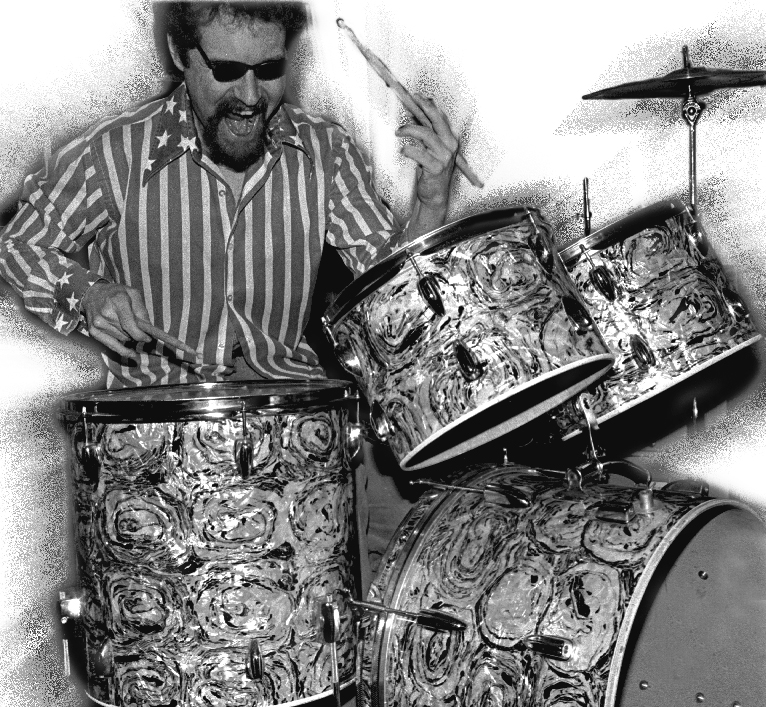
Hal Blaine has always been an inspiration to me. He calls himself the most recorded drummer of all time, and the evidence seems to support him. And his quality matches his quantity. In addition to pounding the definitive Phil Spector beat on “Be My Baby,” the skins man provided precise stick- and footwork on “Return to Sender,” “Good Vibrations,” and even Dino’s “Everybody Loves Somebody,” as well as hundreds of chart-toppers through the late ’70s.

All of which is to say I’m no Hal Blaine. But these tracks display a certain versatility, if nothing else. First up is a disco song. I think disco was already dead when we recorded this at Omega Studios in Kensington. I am unashamed to say that the beat is fun to play and if asked, I would play it again. So there.

“Another Eight Hours”

My only entry into the world of Christian Rock came via an intense young man named David Coggeshall. Producer Caltrick Simone (ne Stein) was unafraid to put his money into a work of unabashed Godliness. And, miracle of miracles, the tune was pick-hit-of-the-week on WINX-AM radio in Rockville. (Or WPGC. I’ll fact-check this later.) Not sure what happened to Mr. Coggeshall. Hope he’s not in Hell.

“Give Your Life to Him”

I remember this session, but not the names of anybody involved. It was the ’70s, make your own joke. I recall that a couple Georgetown or GW students, or grad students, had a bunch of songs they wanted recorded and I got the call. One guy’s tunes were wacky folky things that he presented with more enthusiasm than authority. But the other guy was more serious and his song has an Andy Williams vibe that I kinda dig. If Andy Williams has any vibe.

“Carrie’s Plane Is Leaving”

Another Dan Pasley session. I think this was supposed to be part of a musical, or something. Dan’s commercial work was always trying to be theatrical, and his theatrical work hoped to be commercial. Recorded this in the basement of a tract house in PG County. Again, can’t recall the singer, a spunky little gal with a big voice.

“Nashville Women”


A sports writer, TV writer, music writer, and a drummer walk into a recording studio. Here’s music recorded in this century, recorded at the fabtabulous Scary Clown Studios, in fact, by the equally splenderiffic Philip Stevenson.

The first session, we got right down to recording the theme song for the music writer’s radio show. Which had been canceled some weeks previous. Still, there was a need for closure. I’m sure the three people who listened to the program are retroactively delighted to finally have a tune to hum along to while not waiting to dial in.

“The Theme From the (Canceled) Music Show”


The second tune was inspired by an interview with Don Kirshner, he of the fabled ABC show In Concert, the show that introduced Alice Cooper to much of America. Don also introduced us to the music of the Monkees, a fact the Monkees themselves are still not too happy about.

Anyway, we did the song, then stuck in real and imagined quotes from the interview. It’s not Don, of course, saying these things. But it’s certainly the spirit of Don. And the spirit of Don is what’s kept this country free.

“Plump Little Fingers, “The Chocolate Thing”

The Soundtrack Remains the Same

Ludwig Super Classic at Track Studios

While I wait for Danny Elfman or Hans Zimmer to call, here’s some music I recorded for a couple of industrial films.

Until the early ’80s, Washington, D.C., was a hotbed of taxpayer-supported documentaries, training films, and informational filmmaking. Almost none of it was necessary. Like everyone else, I was happy to take the cash.

Tragically, I never got a copy of any of the tunes from my greatest session, a song cycle for the film School Bus Safety and You. I did keep the sheet music, and the lyrics stick with me these many decades later:

Be at your bus stop on time
Always wait by the yellow line
Be careful, courteous, and kind
And ride the bus that your assigned

If you can imagine the cloying sing-songiness, you are only halfway to imagining the extremely cloying sing-songiness. Barney would be proud.

Anyway, the first tune is from a film created to explain the wacky new “European-style” road signs that the government was forcing on unsuspecting Americans. You know, the red circle-and-slash? Whose meaning is pretty close to obvious. Yes, there was a time when the U.S. didn’t take its marching orders — and don’t-walk orders — from France. Of the dozen or so cuts, I think this track states the theme nicely, don’t you?

The European Way…

UPDATE: After listening to this again, I do believe that Tommy Hannum is playing the pedal steel on the track. Tommy’s big in Nashville these days, but back then he was a member of the Rosslyn Mountain Boys.

The 1970s were dangerous time. For one thing, Al Gore was preoccupied with courting Tipper, leaving the country in the grip of the greatest menace since fluoridation. From the stirring documentary Drinking Water Alert, this song helped win the Vietnam war.

Watch what you drink…

Jingly Jangly Jingles

dave oyster drums

I write elsewhere about the death of the jingle, and these samples may better explain why it died.

You cannot have listened to the radio in the past, oh, 30 years, and not heard this ditty. Me, bass player Gary Fallwell, and guitar player Chopper spent a whole day at Track Studios in Silver Spring jamming around on various ideas before settling on four notes in a descending pattern repeated over and over. And over. Horns and vocals were added sometime later. Got $25 for the effort. If I’d asked for a five-cent royalty, I’d be rich today. Not a week went by without the Jerry’s Ford jingle playing somewhere. It was syndicated, so I even heard late one night it as I drove into Dallas.

In fact, the jingle was played so much that the master tape wore out. They re-did it with synthesizers some time in the early 2000s. When I heard the new version, I called Jerry himself, looking to get in touch with the original producer, whose name has escaped me. I was going to write an article. When I mentioned that, Jerry got real squirrely and defensive.

“Jerry’s Ford jingle”

I do know the producer’s name for these Blank Pontiac spots: Dan Pasley. Most of my commercial recording work was with Dan, and it was (almost) always a pleasure. Mostly because Dan ran a, shall we say, loose session. Often he’d show up, late, open his briefcase, pull out a bottle, and declare, “Let’s get started.” It was then apparent that whatever we would be recording would be made up on the spot between now and whenever everyone passed out. Good times.

In this session, we cut a bunch of variations on the theme, for the different radio stations. Here’s the WGAY, i.e., white people, version. And this is the WOL downtown black people version. Same damn Pontiacs, of course.

“Blank Pontiac “Wide Tracking” (Smooth)”

“Blank Pontiac “Wide Tracking” (Funky)”

Did a whole bunch of work for the Britches of Georgetown organization thanks to Dan. This is one of my faves, for the chain’s country branch. The Eagles were popular at the time. Guess they still are.

“Britches Western”

NPR Commentaries

First off, I never liked that they called these “commentaries.” Like I’m Daniel Frickin’ Schorr. (Who, I’m surprised to say, my sister-in-law has the hots for. Strange world.)

I prefer to think of these as humorous essays, if anything. But such is the power of All Things Considered, that based on hearing my snide voice on the radio a producer called me to do voiceover work — a task for which I was utterly miscast. I mean, I became the spokesman for the Washington Area Oldsmobile Dealers and I can’t even pronounce Oldsmobile correctly. Don’t believe me? Listen here:

“Big Deal — The Washington Area Oldsmobile Dealers”

Perhaps an insight into why the car is no longer manufactured.

I always offered to do character voices, but the ad geniuses kept demanding Lettermanesque snark or Tom Bodet “sincerity.” One of the directions I got was to sound more like one of the guys on Friends. I never watched Friends. Maybe I was supposed to sound like one of the women on Friends.

Anywhoo…these tracks are me being me. And a little bit Bob Edwards.

“NPR: Bond, James Bond:”

“NPR: Bad Vinyl:”

“NPR: Death of the Hardy Boys?”

“NPR: Hollywood Sequels:”

Very Special to the Washington Post

written by dave nuttycombe for the washington post

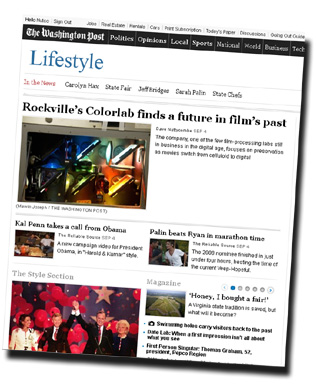
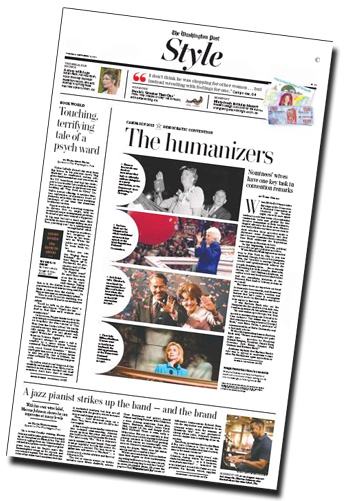
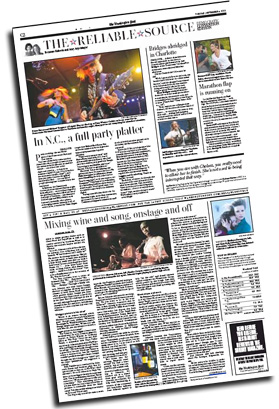
Following closely on my piece about 99-year-old chanteuse Marianne Arden, the Washington Post published two articles I wrote, one about local musician and entrepreneur Marcus Johnson and the other on the future, and past, of film processing business Colorlab.

Shortly after the Colorlab story ran, Landmark Theaters converted local E Street and Bethesda Row cinemas to all-digital. (Here’s a nice write-up in Washington City Paper by Ian Buckwalter.) As someone once said, the future sneaks up on you.

And as the current future allows any and everyone to comment on any and everything they see, hear, and read on the Internet, I must note some of the more amusing notions that Post readers felt necessary to scribble into the aether.

An insightful person going by the nom de net “remember1007” wrote:

“Too bad that, once again, the WashPost has assigned a writer who knows nothing about jazz to write a piece about jazz. Would they send someone to write about a Redskins game who has seen one or two NFL games in his/her life? It’s a great music with a long and distinguished history in DC (Duke Ellington, Shirley Horn, et al), but as usual the Post confines it to these types of uninformed pieces by neophyte writers. I could tell from the first line that, while perhaps well-intentioned, the author knows not of what he speaks.”

written by dave nuttycombe for the washington post

At first I thought remember1007 was mocking my obvious lack of knowledge of the jazz idiom. As just the night before the Post piece ran I had performed, for pay, with a jazz combo that featured a couple members of the august Navy Band the Commodores, and that I’ve been playing jazz and jazz-ish music since age 12, well, he may be on to something.

Then I thought perhaps remember1007 objects to my calling Marcus Johnson a jazz player. True, Johnson himself admits cheerfully to the “smooth jazz” label, a sound scorned by many as bogus and utterly unhip. But my definition of jazz is pretty broad and inclusive. The dictionary (and Wikipedia) definition is that jazz is improvisational, and if remember1007 had witnessed Johnson and his band wailing at Blues Alley, he might have held his typing fingers at bay.

Fortunately, “ReneldaMoorehead” came to my “defense,” writing:

written by dave nuttycombe for the washington post

“Dave Nuttycombe is not a jazz aficionado, granted. But he wrote an outstanding article as a profile of Marcus Johnson.”

OK, granted.

On the Colorlab story, a pedantic former employee of the National Archives takes me to task for ignoring the nuts-and-bolts policies of the Archives and failing to mention Bono Labs, which in fact I mentioned in the first paragraph. And with which I have a personal history, as Joe Bono was the saint who processed and put up with most of Travesty Film‘s tragic film output — even letting us pay over time. Often a long period of time. But that wasn’t the story.

Colorlab’s Russ Suniewick lead me through a vigorous six-hour tour of the elaborate facilities and indeed did discuss Mr. Pedant’s cherished “vendor program” that requires producers to pay for making duplicates that future researchers may access. But there was no room to add all that. I even had to cut some great quotes by Russ’ wife Nancy. (Sorry!)

As with all newspaper articles, what is printed is nowhere near the full or final story.

The Last Chanteuse

written by dave nuttycombe for the washington post

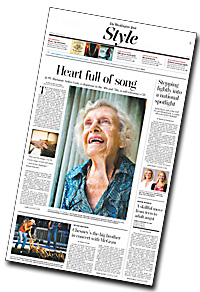
Had the delight to interview Marianne Arden Cook for the Washington Post. Marianne is 99-years-young, as they say, and with her it’s true. I could hardly keep her hands off me! (Not really lying.)

The occasion was because the one-time traveling chanteuse is putting out an album of her original songs. She’s written 130, she says. She sang some for me.

Here is the link to the article.

An added delight on this assignment was that the photos were taken by my dear old friend Bill O’Leary. A gallery of his images is here.

Also cool is that I shared the page with Molly Ringwald! Well, a review of her new novel. Which is apparently quite good. Yay for Molly! I’m gonna buy it.

I sent the Post some MP3s of Marianne’s tunes, which they chose not to run, for some reason. So I will include one here. Maybe my favorite, “I Remember (Boom Boom).” It’s so very of its time and place and I find it rather haunting. Enjoy.

Rock & Roll Will Never Die — If The Fabulous Hubcaps Have Anything To Say About It.

hubcaps washington post

My piece on the Fabulous Hubcaps takes over most of the front page of the Washington Post Style section today. The assignment called for 1,200 words. I wound up with nearly 13,000 transcribed words. So I think I undersold the piece. Coulda been a magazine feature, ’cause there was sooo much fascinating, fun, and relevant info that did not make the cut. I will say that I’m glad to be able to use the serial comma again. Also, when will publications stop putting a K in the abbreviation of microphone? It’s mic, not mike. Mike is a person.

But these are personal peeves and not aimed at any of the fine staffers and friends at the Post. Go, newspapers!