Come On, Get Happy

Ken and Jeannie Veltz and their children were a real-life Partridge Family. After the band broke up, Mom and Dad hit the road alone, trying to keep the music alive.

written by dave nuttycombe for the washington post

[NOTE: A truncated version of this piece ran in the Washington Post, which you may read here. That piece excised two-thirds of the story to focus on the parents. While their journey was certainly the hook, this longer version provides much deeper history, context, and insight, as well as a closer look into the curious machinations of the so-called music business. I had, after all, spent a decade following the story; there was lots to say. Also, I’ve changed the diminutive of microphone back to “mic” from “mike.” There is no K in microphone.]

KEN AND JEANNIE VELTZ ARE DRIVING to an open-mic in Old Town. The couple mapped several such spots into the GPS for this Thursday night. A guitar rides shotgun in the back seat; the trunk is filled with sound and music equipment. The duo are scheduled to perform at Iota on Sunday and, as Ken says, “You can’t roll around with the grandbabies all day.” Playing live will limber the pair up, get them ready for the paying gig.

Unlike most of the plaintive singers on the D.C. open-mic circuit, Ken and Jeannie are in fact grandparents, twice over. Also separating them from the usual six-string strummers: they have a Wikipedia page. As the band Cecilia, the Veltzes were signed to Atlantic Records. It wasn’t just the two, it was the entire family: son Drew on lead guitar, daughters Laura and Allison singing, dad on rhythm guitar and percussion, mom completing the three-part harmonies and shaking the tambourine.

Yes, just like the Partridge Family. But real and with much better music.

And a bus, of course. It didn’t have a multi-colored Mondrian paint job, but the family did tour nationally for most of the previous decade. They were courted by MTV and Hollywood film crews, wined and dined and lived as much of the rock star life as a fairly well-adjusted musical family cared to live.

Before the label deal, when the Veltzes were just a family band from Vienna, Va., this is what The Washington Post had to say about Cecilia in 1999:

“If you care at all for melody, harmony and good songs, you must go see Cecilia. If you want to let music do what it’s supposed to do (fill your heart and soul and make you glad to be alive), you must go see Cecilia.

The family seemed poised to climb to the top of the Top 40. But, like thousands before them, the Veltzes discovered that a set full of catchy tunes and club full of eager fans is not always enough. Unlike thousands before them, Ken and Jeannie refuse to let rejection define them. Even faced with a failing economy, the aging Boomers are betting everything on one more grab at the brass ring. The couple has 37 years together singing happy, upbeat songs

Non More Non

The Paranoid’s Pocket Guide:
Hundreds of Things You Never Knew You Had to Worry About

By Cameron Tuttle
Chronicle Books, 143 pp., $10.95

All About Me
By Philipp Keel
Broadway Books, 86 pp., $12

The Lounge Lizard Journal
Designed by Michael Mabry
Text by Sam Wick, Bradley Temkin, and David Wick
Chronicle Books, 128 pp., $18.95

OURS IS A TIME OF INFORMATION OVERLOAD. The load is getting heavier, and the information is getting worse. One morning the front pages of all the world’s newspapers scream the formerly unthinkable news that an asteroid is coming to crash into the Earth. Our minds instantly fill with frantic calculations, seeking hints of possible reprieve. “Lawmaker Urges Asteroid Interceptor,” reads a late-edition headline. Twenty years ago, that sentence would have been gobbledygook.

But before the comedians can leap into action and prepare a sturdy supply of witticisms with which to deal with the tragedy—in fact, the very next day—the newspapers are denying the crisis. A scientist has miscalculated.

Instant crisis, instant crisis averted. But there is no relief. We are stuck with a new, vague sense of dread as well as some lingering notions about interplanetary movement that have no value in our daily lives but that will undoubtedly crowd out some other previously held semi-useful data—like how many pints in a liter. If, in fact, there are any pints in a liter. I’ve forgotten. But I recall that the asteroid interceptor will cost $25 million. It has my vote.

The weight of utterly useless information has driven even such a respected figure as JFK confidant Pierre Salinger mad to the point of calling a press conference to warn of conspiracies and disaster—based on a bogus report he found floating through the web. How was he to know it was wrong? The Internet is, after all, the Information Superhighway.

Gerald Celente, author of Trends 2000, a book about where we are headed, was recently quoted in the Washington Post to the effect that eventually this data deluge of “nonessential essential information” will cause our creative senses to wither. Every time you start Office 98, you move closer to becoming one of Celente’s “corporate quantitative thinkers,” who require only lists, charts, numbers, and stats for satisfaction. Thus the nonbook is both the effect and the epitome of the information explosion. Two of the three books considered here are so non as to contain almost no content whatsoever. The third is a new handbook for our times.

paranoid guide

That book is Cameron Tuttle’s witty digest, The Paranoid’s Pocket Guide: Hundreds of Things You Never Knew You Had to Worry About. The cover suggests that we should “practice defensive living,” but really there is no defense from much of what she presents. Tuttle dispenses with technical explanations, footnotes, or debate, opting instead for a numbing catalog of afflictions and conditions, possibilities and probabilities of everything that can, and surely will, go terribly, terribly wrong. Interspersed are short statistical “Fright Bites,” but the whole bite-size book is frightening.

Consider:

  • If you sneeze too hard, you can fracture a rib. If you try to suppress a sneeze, you can rupture a blood vessel in your head or neck and die. A long yawn can break your jawbone.

  • Dance-floor dehydration can kill you.
  • Cold- and warm-water laundry cycles will not kill the bacteria and microscopic insects living in your clothes and sheets. Newly worried about insects living on your shirts and pillowcases? Think about this phrase: African eye worm.
  • Or, Hello, operator: Saliva is a steady source of nutrients to microorganisms living inside a telephone mouthpiece. Then again, you can be electrocuted while talking on the phone during a thunderstorm.
  • Those keyless remotes that unlock your car? The tone can be recorded and then played back to open your car when you’re not around.
  • But there is good news: More people in the advertising business die on the job than those in petroleum refining.

    IS ANY OF THIS TRUE? It doesn’t matter. It sounds possible. Ask Pierre Salinger. The Paranoid’s Pocket Guide is destined to keep appearing in annually updated editions.

    paranoid guide

    The nonest of nonbooks is the journal. These are books that absolutely must be judged by their covers, as there is nothing else to judge. Sold mostly in art supply and stationery stores, they are sheets of blank paper between fancy, often textured, covers. They are intended to be filled with the pithy prose and/or pretty pictures of one’s life. Philipp Keel’s All About Me removes most of the guesswork involved in keeping a journal. One only has to fill in the blanks, answering his questions or choosing from a list of options he has supplied.

    “With questions you not only reveal your curiosity to others, you also invite others to express their feelings, wishes, and fears,” writes Keel, in the book’s only prose.

    He divides existence into categories like Opinions (“What is your opinion of the right to own guns: [ ] Pro [ ] Con”), Family (“Three things you like about your mother:”), Ego (“A special compliment that made you blush:”), Wishes and Dreams (“How you plan to spend the last years of your life:”), Sexuality (“A fantastic kisser you have known:”), If (“If you were a plant, you would be:”), Yes or No (“You like hiking, [ ] Yes [ ] No”), Measure Your Fears (“Pet a snake: [ ] You did. [ ] You would. [ ] You would not.”). And like that.

    I can see how some may benefit by answering these prompts (“A friend you should not have kissed:”), but I would be afraid of anyone who handed me a completed book like this. I would be afraid if anyone found a book like this that I had completed. I would rather be struck by an asteroid.

    With its deep-orange faux-alligator skin cover, The Lounge Lizard Journal is a gorgeous piece of nonness. Like All About Me, it is intended for recording one’s swinging life. A handy page of stickers is included, should you need to label anything “Swank” or “Let’s Swing.”

    There are six “chapters”: The Threads, The Cocktail, The Hi-Fi, The Foxes, The Bachelor Den, and The Films, and an appendix, The Hi-Life, which lists simpatico books, web sites, bars, and drink mixes. The tiny introduction frankly states that the book is a “personal invitation to join the domain of the Rat Pack,” an enduringly impossible dream of the latter half of the 20th century.

    But there is no real information about these topics, just decorative art. Much of what passes for content in Lounge is sampled—images from old ads, phrases, slogans, and quotations, some lifted from the liner notes of recent CD collections of lounge music, themselves repackagings of the past.

    The compilers did venture as far back as the ’20s for Algonquin wit Robert Benchley’s line, “Let’s get out of these wet clothes and into a dry martini.” They also quote the very modernly unmodern Combustible Edison’s mantra, “In all things, be fabulous.”

    paranoid guide

    Mostly the pages contain only lines superimposed over a snappy design. To paraphrase eminent philosopher-naif Nigel Tufnel, how much more non can a book get? None.

    At this point, the lounge revolution is more a design movement than a musical or fashion one. It persists because art directors can’t resist the lure of atomic ovals, floating boomerang shapes, and duotoned populuxe splendor. The best ’50s and ’60s design is happening right now.

    Chronicle Books is very successful at repackaging this century, producing endless volumes of fetishistically gorgeous pictures of the way we wished we were and the things we used to possess or want to possess. Call it yuppie porn. Thumbing through these beautiful, empty pages, I came to believe that the only safe place to live in the world of tomorrow is yesterday.

    Reprinted from Washington City Paper

    The Road Non Taken

    State by State With the State
    By the State
    Hyperion, 271 pp., $10.95, paper

    An American Festival of “World Capitals”
    By Laura Bergheim
    John Wiley, 299 pp., $14.95, paper

    AMERICANS LOVE TO TRAVEL, but we frankly don’t give a damn about the rest of the world. And why should we? From sea to shining sea, a person could spend a lifetime exploring the curiosities along our blue highways and never see it all. Or learn a thing.

    Which is why State By State With the State is the perfect travel guide for the Ugly American. As the subtitle explains, it is “An Uninformed, Poorly Researched Guide to the United States.” A witty celebration of ignorance, it won’t even make you feel like traveling.

    A guess: The inspiration for this book was its title. Another guess: The group never left the confines of New York City&#151never left their apartments&#151to write this “guidebook” to the U.S.A.

    The State is a many-person comedy troupe, none of whom is particularly distinguishable, even the lone female. Its MTV show aired during a glut of sketch-troupe shows, and seemed like just more of the same. But what was a weakness on television is a strength in print. Many similar voices blend well, while also providing a subtle variety that a single writer would likely not have achieved.

    From the dedication to the utterly useless made-up index, this is nonsense, pure and simple. But the best kind of nonsense: loose, wild, and quick. Most of the items don’t even have a premise, they just start silly and riff on their own inanity. This can be an exceptionally unfunny technique, made more excruciating with length. Here, it works. The authors create a giddy mood&#151happy ignorance on holiday&#151and build on it.

    state by state by state

    The cover proudly proclaims, “Finally Without Maps!,” though there are outlines of states. The country is divided into the usual regions, and each state is given its due, either playing up stereotypes or creating fresh ones.

    For instance, under “Georgia Events and Activities,” we learn that “the Georgia Film Festival runs from June 3 through July 3 and features some of Palestine, Syria, and Jordan’s finest new directors. Security is high and attendance low, so good seats are easy to come by.”

    Fort Lauderdale is wonderfully described as “the French Riviera of Terrible Awfulness.”

    There is a list of “Things You Don’t Overhear in a Bar in Jackson, Alabama,” that includes, “Group hug!” and “I don’t really like Charlie Daniels’ music, but, Christ, what an ass!” and “Why can’t I find me a woman like Yoko Ono?”

    They don’t just pick on the easy-target South. The group offers an “Iowa-Kansas-Nebraska Weekend Romp” (for some reason trademarked): “You want to see Kansas, Iowa, and Nebraska, but all you have is three days? Not to worry. Just follow this plan to get the most out of the time you have. And remember: This is only a guide. Feel free to adjust the following itinerary to tailor it to your own needs. Day 1: Kansas. Day 2: Iowa. Day 3: Nebraska.”

    And how does our fair city rate? Though we’ve yet to achieve statehood, Washington joins the other 50 in being pointlessly dismissed. While Republican- and Democrat-spotting and a visit to the “life-size” Lincoln Memorial are suggested, the best our town has to offer is Dunkin’ Donuts. “There’s nothing special about the ones in Washington,” the writers note, “but we think that going to Dunkin’ Donuts is special enough. (We recommend the donuts.)”

    I do have a pathetic quibble with the entirely useless index. Listed is “Mxlplx, Mr.” Surely they mean Superman’s annoying visitor from another dimension, Mr. Mxyzptlk!

    The section on Road Games is laugh-out-loud funny. Such time-passers as “Lick the Seat Belts,” “Try, Try to Punch My Eye,” and “What Did I Have for Lunch” may seem obvious. However, many of these games must be played using 13 20-sided dice.

    You don’t read this book, you nibble at it, starting anywhere. And like the unhealthy bag of potato chips it resembles, you’ll find yourself gobbling more than you intended.

    TO WRITE HER BOOK, Laura Bergheim most likely did get out of the house, if only to go the library. Though she disclaims that it is “not a scientific or comprehensive directory,” An American Festival of “World Capitals”: From Garlic Queens to Cherry Parades (A Guide to “World Capitals” of Arts, Crafts, Food, Culture, and Sport) is fairly extensive and full of useful information, for both the serious seeker of Americana and the ironic traveler out to snicker at the locals.

    world capitals

    It’s typically American to proclaim so many “World” capitals, and then only list ones in the United States. Maybe Solvang, Calif., is the “Danish Capital of the World.” Maybe the pastries in Denmark are really lousy.

    But Bergheim is an enthusiastic booster, and she presents a uncritical tour of our globe-trumping greatness. Many of the illustrations are courtesy of local Chamber of Commerces, so while Las Vegas is described as the “Entertainment Capital of the World,” don’t expect a mention of its active prostitution industry.

    World Capitals is organized by category rather than by state, so those planning a trip must read the book rather than skim the contents for an itinerary. Bergheim not only lists dates for annual festivals and celebrations, but provides addresses, phone numbers, contacts, and offers recommended reading (which not surprisingly includes Charles Kuralt’s books).

    Many “capitals” earned their titles over time as a result of industry developing around natural resources or local traditions spawned by immigrant or like-minded populations. More and more, capitals are self-proclaimed, awarded by local business or government eager for tourist dollars. If one expected that New York City would be the Bagel Capital, one would be wrong. That honor belongs, of course, to Matoon, Ill. Matoon is the home of the Lender’s factory. Lender’s sells a lot of frozen bagels and wants you to know it.

    The text is broken up by many “Did You Know” sidebars, aimed at readers not entirely in the know, like this mention of “Lutefisk Capital U.S.A.,” Madison, Minn.: “As if the briney [sic] codfish dish weren’t famous enough, MTV viewers swallowed an unanticipated dose of fisk, courtesy of Lutefisk, the band.”

    Tacit acknowledgment is made of the fact that eventually most travel will be done without leaving one’s chair. “Cyberspace Contacts” provide pointers to capital-related web sites, such as toyfarmer.com, which the Farm Toy Capital. There are four farm-toy manufacturers located in the Dyersville area. Go figure.

    DESPITE THE HAPPY TONE of the book, all is not entirely peaceful in World Capital Land. There are the many rival Capitals. Watermelons and spinach have several claimants. Bergheim wisely admits that the many regional varieties of barbecue are each justly deserving. Thus Kansas City, Memphis, Texas, North Carolina, and Kentucky may all share the crown. (She also explains the Spanish roots of the word “barbecue.”)

    But some of the rivalries make as little sense as what they commemorate. For some reason, Sun Prairie, Wis., believes it has more of a claim on being America’s Groundhog Capital than Punxsutawney, Pa.&#151even though their woodchuck, “Jimmy,” arrived 61 years after the justly famous Phil.

    This is the dark side of Chamber of Commerce greed and provincial chauvinism. Punxsutawney’s tradition grew honestly from its German-immigrant population and natural abundance of groundhogs, and has been dutifully maintained since 1887. To think that mayoral proclamations and press releases can rewrite history is simply insulting.

    Even online, Punxsutawney rules. Compare Punxsutawney’s elegant URL (www.groundhog.org) to Sun Prairie’s geeky gibberish (http://tmcweb.com/sorairie/ghog.htm). Please.

    I will say this to Sun Prairie: Give it up. You’re nuts. The people of Sun Prairie are stupid idiots if they think anybody cares about their pathetic furball.

    It is such pigheadedness that makes Americans so damn ugly.

    Reprinted from Washington City Paper

    Making a List, Spell-Checking It Twice

    For the Love of Cheese
    Might Magazine
    Boulevard Books

    What NOT to Name Your Baby
    Andy Meisler and Michael Rey
    Ten Speed Press

    Do You Remember?
    Michael Gitter and Sylvie Anapol
    Chronicle Books

    WHAT THE HELL HAPPENED TO LITERARY HUMOR? Anyway? Visit the humor section of any bookstore and you will not find much funny fiction. Oh, the better shops may have a Thurber collection, a Wodehouse or two, possibly a Tom Sharpe paperback. Mostly, what you will find will be recycled collections of newspaper cartoons that were barely amusing in the first place. And all 97 volumes of the “Tasteless Jokes” series.

    The situation is getting worse. Paging through Publishers Weekly for upcoming releases reveals that the future of print humor is: Cats. And Dogs. These are a some of the actual titles you can expect to find filed under “Humor” in the coming season: Listening to Catnip: Stories From a Catanalyst’s Couch, Historical Cats, Bedtime Stories for Dogs, A Cat’s Christmas, Holiday Hounds: Songs for Festive Dogs, 101 Reasons Why Cats Make Great Kids. And, of course, let’s not forget Garfield, who, being both a cat and a cartoon represents the ne plus ultra of modern humor.

    Ha. Ha.

    Hardly anyone, it seems, is writing comical prose. And what work there is gets hidden in the overcrowded stacks of General Fiction, to be utterly ignored by everyone. It was only by happenstance that I stumbled across the funniest book of recent memory, Roddy Doyle’s hysterical The Commitments (Forget the movie, which completely missed the point, the book is a gut-buster). Likewise, the little-known works of Jay Cronley (Quick Change, Funny Farm) are routinely pushed off the shelf each time Clive Cussler releases a new volume.

    Of course, who can blame an author for not wishing to have his work sandwiched between an oversize edition of For Better or Worse comics and the collected wisdom of a TV comedian.

    In fact, since the death of P.G. Wodehouse, writers regularly producing amusing fiction have been scarce. Before he abandoned comic filmmaking, Woody Allen generated three slim volumes of very funny stories. He seems to have abandoned this as well.

    I BLAME THIS SHIFT IN TASTE AND STYLE on the computer. (I blame everything on the computer, but that’s fodder for another day.) Compare humor styles before and after computers became ubiquitous.

    In the typewriter-bound ’70s, the epitome of print humor was to be found in the National Lampoon. Though the magazine broke new ground in its use of language, attitude, and subject matter, in the main it still trafficked in the traditional form of wringing laughter from prose. If S.J. Perelman had toked up and wandered into the Lampoon offices, his material would have been welcomed. The Lampoon featured long stretches of paragraphs that one was expected to read. Chris Miller and John Hughes wrote lengthy stories with vivid characters.

    By the ’80s, the Lampoon braintrust had dispersed and computers had begun appearing on desktops everywhere. Words were now to be processed. People began “interfacing” with “text,” searching and replacing and compiling backwards and forwards through their databases faster than the blink of an eye. Like ATMs replaced human interaction in the banking industry, digital thinking replaced analog. The advantages of direct access became apparent.

    And so by the late ’80s, the epitome of print humor was Spy magazine. Taking a journalistic approach to comedy–or perhaps a comedic approach to journalism, the Spy editors married a sarcastic point of view with the Lexus/Nexus search engine to perfect the art of Statistical Humor. The magazine got laughs presenting the fine print in contracts. Verbatim. Transcripts of lawsuits were offered for our amusement. As USA Today had done with news, Spy condensed comedy into charts and graphs.

    And it was funny. We are all now prisoners of the Information Age, and like any tyrant, our new master will be mocked. “Stories” with “characters” are relics of an agrarian age, when people had to amuse themselves around a campfire because there was no cable. In a machine-driven age, data rules. The modern humorist is a clever compiler. And so it is that the most common form of joke-telling today is the Top-Ten List.

    And besides, as Chauncey Gardner agreed, “Who has time to read?”

    All of which leads, finally, to the books at hand, which are largely list books. And, largely, funny.

    What NOT to Name Your Baby (Ten Speed Press, Berkeley. 64 pp.) is perhaps the most noteworthy, because it accomplishes the most with the least. It is in fact merely a listing of names, with ’50s-era photos of babies in distress completing the illusion of an actual baby-naming book. Some names are intrinsically funny (Jor-el, Hortense), but authors Meisler and Rey have not merely slapped together a haphazard collection of ridiculous nomenclature. Working through the list reveals a fine and subtle agenda at work. In the girls section, Dee Dee, Gennifer, and Hillary share an uneasy proximity. Then the improbable Soon-Yi pops up. Kathie Lee might at one time have been perfectly acceptable–no more. La Toya, of course, was never a good choice. Likewise, in the boys section, we find the absurd Axl. But the eye almost passes completely by Orenthal before realization hits.

    THIS BOOK PROVIDES A REAL SERVICE, though, when it suggests that no future baby girl should have to go through life as “Kennedy.”

    For the Love of Cheese (Boulevard Books, 140 pp. $12) is subtitled, “A Celebration of All Things Cheesy; A Celebration of Life Itself!” Assembled by the editors of Might magazine, this is not a cookbook, but a report on “the very cement that holds this nation together.” Their cheese, like this country, is “everything big and flashy and shiny and squishy.”

    There are grades of Might-style cheese. “Velveeta” is typical and tacky and “too obvious to care much about (Animal sidekick movies, fuzzy dice, white shoes, early Bette Midler). “Dorky” is a slight step up, but more to be pitied than scorned (Fern bars, Pictionary, screen savers). “Evil” cheese makes us shudder (being a vegetarian who only eats “chicken and fish,” car commercials that pretend that their assembly line workers love their jobs, Al D’Amato).

    But the cheese that Cheese is most concerned with is “Supracheese.” Cheesy, but also fun, it is the “cheese we all share.” Cheese is not an attack on “big-hair-mall-rat-semi-suburban-morons.” The authors bravely admit, “It’s us.”

    In tiny, tiny print, three columns to a page, the compilers insightfully sum up so much of the current condition in short, simple phrases. Their “Linnaean taxonomy” includes “Going Out Cheese” (dancing in front of the mirror naked, dancing in front of the mirror fully clothed, dancing in front of the mirror trying out a new dance, practicing your smile, practicing your laugh, putting a condom in your wallet “just in case”), “Political Cheese” (calling yourself a technocrat), “Corporate Cheese” (colored paperclips, the “I-don’t-know-what-to-say-to-you-because-I’ve-already-said-good-morning” smile and wink, employee discount clubs), “Sports Cheese” (Mascots, mascot antics, mascots frolicking with other mascots, mascots doing push-ups, mascots doing push-ups but then giving up after a few, ha ha), “Being in a Rock Band Cheese” (Closing your eyes while you sing; the “no-chicks-at-practice” rule; pointing to someone in the audience; being big in Japan), and many, many more.

    An impressive work, but not entirely new. Steve Miller was on to the same thing when he shouted during the fade-out of his 1968 song, “Living in the U.S.A.,” “Somebody give me a cheeseburger!”

    Do You Remember? (Chronicle Books, 144 pp $9.95) is funny insofar as one has a sense of humor about oneself. A compendium of pop culture icons, images, slogans, catchphrases, and fads, it catalogs decades of silliness–mostly Boomer-related, but also covering important talismans of Gen-X vintage: “Right foot yellow!,” “Cassius Clay,” “Jarts,” “Dyn-O-Mite!” Boldly designed, it would be an attractive coffee table book, except that it measures only 6 1/2 inches square.

    The most useful aspect of Do You Remember is its index. How helpful it would be to have this one-stop guide to the fancies of the last 40 years digitized on a CD-ROM, where it could be searched at the click of a button. A serious lapse on the part of the publishers. This is, after all, the computer age. Print, as the great scientific genius Egon Spengler noted, is dead.

    Reprinted from Washington City Paper

    Read More Non Book Reviews Here:
    The Road Non Taken.
    None More Non

    …But I Know What I Like

    “Winter is icummen in,” quoth Ezra Pound, “Sing: Goddamn.”

    Actually, winter has been so goddamn icummen that cabin fever is about to drive me as insane as poor Ez. Sick of huddling indoors staring at the same walls, I switch to staring at the TV — and suddenly, salvation. An ad for the Collectors Art Sale (Sunday Only!). “Original Art” for less than the cost of a lube job. That’s it: Art — the perfect mid-season pick-me-up.

    I trudge through the melting muck into the Gaithersburg Holiday Inn half expecting acres of sad-eyed cats and gaudy-colored clowns. Still, I am unprepared for the first image encountered: a painted trio of grinning harlequins, each bearing an uncanny resemblance to Ed Meese. Quickly, I turn away.

    And stare across a meeting room packed with stacks of canvases, ten deep in places. A few dozen average Joes, Janes, Jorges, and Lu-Tans quietly browse amid the very faint smell of linseed oil. There are no velvet ropes to impede their quest; this is hands-on experience.

    Donna Bower stands intently before a large rectangular framed canvas of a purplish Alps-scape. “This one keeps drawing me back,” she says in a reverent whisper. Donna lives nearby and has a lot of wall space to cover. The two smaller works she’s already bought aren’t quite up to the task, but the $495 price tag on the Alpine village is a budget-buster.

    “You have a big sofa?” a clerk asks, giving voice to the cliche. “A big, big sofa,” pipes in Donna’s friend, Don. “It’s a sectional,” explains Donna.

    The discussion moves to frames, which rather greatly affect the picture prices. In fact, there is so little talk of aesthetics and so much of frames, one suspects that this is actually a frame sale. G.K. Chesterton once remarked that the most beautiful part of every picture is the frame. I don’t think he’d seen these purple Alps when he said it, though.

    Where does all this…art…come from? I ask Lisa Kellum, the representative of Collectors Art, Inc., the Chicago-based company hosting this event. Kellum’s business card reads: “Fine Art Consultant.”

    “They are professional artists from all over the world, as well as American artists,” Kellum is cheerful to divulge. Before I can form a new question, she rushes to quash the rumor that these paintings are the work of mere students. Collectors Art acquires only the output of trained professionals, she insists. A sign behind her states that if one believes he has the ability to produce collectible art, one may submit photos of such work for consideration. Later, as I leave, a matronly Asian woman is eagerly inquiring about this policy.

    Noting the wide range of prices, Kellum points out the “gallery setting” on the far side of the room, where art is priced “according to the artist.”

    Thus, if one cares to own an original “Simpson” — in this case a triumphant portrait of Napoleon on horseback — one must pony up $695. If your wall cries out to be adorned with frolicking nymphs in the Titian, excuse me, “Richard” style, prepare to part with $1,200. Some works are twice that.

    I have been searching for a Bob Ross. Ross is the fuzzy-bearded, brown-afroed, whisper-voiced host of TV’s Joy of Painting who spends less than 30 minutes to create paintings that look much like the ones displayed here — lots of pallet-knifed tree trunks with sponge-applied foliage below towering, titanium-white-capped implied mountains. Or mighty, translucent waves crashing upon craggy beaches (your choice, dawn or sunset). Sadly, there are no Bob Rosses.

    Though the average price seems far above the promoted $45, business appears brisk and no one’s yelling “bait-and-switch.” (A call to Collectors Art honcho Martin Hancock a few days later reveals that one unsatisfied customer complained that his painting smelled like fish. This is apparently not an industry-wide problem, and the customer received a full refund. Otherwise, Hancock is tight-lipped about his business, offering only that D.C. is “sometimes a good market and sometimes isn’t.”)

    In two corners of the room stand black tents where individual works may be studied without distraction. A young man in stonewashed jeans contemplates an Impressionist-style street scene with one of the staff. Apparently unaware that the man wearing the name tag — EDWARD — is not an art historian but a temp worker hired for the day to help move the product, the customer openly seeks advice: “Tell me what you think.”

    Edward gives a small laugh, then turns to assay the canvas. “It’s a good painting,” Edward says. “It’s a fine painting,” he says, a bit more forcefully. Finally, Edward sums up the work: “It’s Paris.”

    Ah, Paris! To have been there in the ’20s, wandering through piles of freshly-minted masterworks by Picasso and his pals. To pick up Nude Descending a Staircase for 45 francs (frame not included)….

    That brief fantasy is quickly shattered and one is brought swiftly back to Maryland by a quarrel erupting over a picture frame. A man has chosen a “gold” frame for a sofa-worthy seascape. The temp is trying to explain that the frame was misplaced in the wrong — less expensive — stack when Mr. Short-fuse Art Patron instantly escalates the dispute with the loud line: “Are you calling me a liar?” Clearly not being paid enough for such a debate, the temp walks away with a disgusted wave of her hand.

    But I shan’t let such boorishness ruin my mood. I shall stick by 19th-century English critic John Ruskin‘s assessment: “They are good furniture pictures, unworthy of praise, and undeserving of blame.” Always a sucker for the heady fumes of Art, I succumb to its spell and pull plastic to acquire a small mountainscape by — guessing here — G., or A., Whitman. The first pink light of dawn is upon the peak and with it, I’d like to think, Spring.

    Now, all I need is to find a brown easy chair — with just a hint of azure — to match.

    Reprinted from Washington City Paper.

    They’re Playing Our Song (to Death)

    Who Killed the Jingle? How a Unique American Art Form Disappeared

    By Steve Karmen

    Hal Leonard, 184 pp., $22.95

    STEVE KARMEN’S TITLE ASKS A FAIR QUESTION: How did the once ubiquitous advertising jingle come to die? And, as the People-proclaimed “King of the Jingle,” he brings an informed perspective to the quest for an answer. Now retired, Karmen is fiercely proud to be responsible for such instantly recognizable tunes as “I Love New York,” “This Bud’s for You,” “Nationwide Is on Your Side,” and many dozens more pieces of musical Americana. If he doesn’t name a particular murderous “who,” his book is yet another chapter in the “why everything is going wrong” casebook.

    Though many occupations and products have disappeared because of technology, we can’t blame the Internet or digitalization for the loss of “Oh-oh, Spaghetti-Os.” The real culprit in the case of the vanishing jingle and its replacement with rearranged or simply appropriated popular music is that, as one composer told Karmen, “No one thinks anymore. Imitation is the sincerest form of not having an original idea.” And no one wants to stick his neck out.

    Underpinning the unoriginality, of course, is fear. Karmen spoke with many people in the biz for his book, and nearly everyone reflexively declined to speak on the record, no matter how inoffensive the quote. Fear grips ad people from inside and out, because they’re at the mercy of forces they can’t control: Advertising is neither art nor science, though it pretends to both. Despite the fact that Ridley Scott directed it, that 30-second minimovie fails as art because the product is always the star. And if you want to talk market research, I have two words for you: New Coke.

    Coca-Cola’s CEO in 1984, Roberto Goizueta

    Tiki Tiki Boom Boom

    It Don’t Mean a Thing If It Ain’t Got That Boink

    Space Age Bachelor Pad Music
    Esquivel!
    Bar None

    In considering the work of Mexican arranger/composer/bandleader Juan Garcia Esquivel, one is reminded of the words of Edd “Kookie” Burns, who said it best when he remarked: “Wowsville, daddy-o!”

    Simplemente Esquivel

    Of course, he was speaking in an entirely different context, but the sentiment remains apt. The 14 tracks on Space Age Bachelor Pad Music, a reissue of some of Esquivel’s most distinctive recordings, are stubbornly resistant to categorization. Even Esquivel has trouble describing Esquivel! music; one of his three originals is titled “Whatchamacallit.”

    It is appropriate during this so-called “easy listening revival” that Esquivel’s genius should be finally recognized. While such trend-spotters as Newsweek have proclaimed that a “cocktail nation” is bubbling away among disaffected grungers, most of the bands comprising it seem to be under the misapprehension that merely donning evening dress and turning down the amps is all that’s required to be considered a happening sophisticate. Even a cursory listen to Bachelor Pad should reveal that being “easy” isn’t that easy.

    A contemporary of that avatar of exotica, Martin Denny (whose 1957 hit, “Quiet Village,” with its human-produced jungle animal noises and Polynesian instrumentation, began the craze for hypnotic “tiki” sounds), Esquivel released a series of instrumental albums beginning in 1957 and continuing through 1968. While this era coincides with rock ‘n’ roll’s wildest pre-teen years, you wouldn’t know it from listening to this record.

    Most of the songs on Bachelor Pad were familiar middle-of-the-road standards long before Esquivel got to them. His versions, however, are at once familiar and utterly foreign. In Esquivel’s hands, “Harlem Nocturne” sounds as if the arranger took the A train uptown via Saturn

    Battle Axes

    The Art of War Meets the Art of Noise at the Battle of the Bands.

    IN THE NARROW CONCRETE HALLWAY, thick-muscled young men wrestle heavy, sophisticated equipment into position. Pulses quicken as they work against the clock. They are only too aware that out there, in the dark, eyes are watching…studying…waiting for the first misstep. There will be no second chance tonight. Victory or defeat. A tall, lean figure straps on his hardware and steps into the light, preparing to take the first shot:

    “Test. Testing one two. More guitar in the monitor.”

    The battle is under way.

    Though a life in music is usually considered a gentle calling, there is a history of bitter conflict alongside the sweet harmonies–trumpets raised in anger, sounding the charge for the Battle of the Bands.

    Competition is very much a part of the arts: Sculptors, painters, classical pianists, all compete for grants and awards. But these honoraria are never referred to as combat medals. So, why in the pop arena are such contests branded with the mark of hostility and bloodshed?

    Seeking clarification of such semantic distinctions brought me to Virginia last Thursday night to witness the George Mason University Ninth Annual Battle of the Bands. Sponsored by the Student Program Board as a showcase for campus talent, each musical group must claim at least one registered student. (Tonight’s event sports ringers as old as 35 and even a resident of West Virginia.)

    In the interest of full disclosure, I must mention that I am a survivor of such musical militarism. The third gig I ever played–LBJ was still in office–was a CYO dance organized as a Battle of the Bands. Against a sartorially coordinated, betuxed and behorned soul “revue” (i.e., they had dance steps) and a band of older and better musicians, my ragtag combo, The Fifth (“Music for Every Occasion”), emerged victorious. This was due largely to the fact that we played last and performed our “show-stopping” cover of James Brown‘s “Try Me.” (Picture our singer, a pudgy P.G. County white kid, doing the drop-to-your-knees, feign-emotional-agony bit for a roomful of pubescent Catholic girls.)

    These curious clashes have been occurring since at least the swing era. In fact, the night of May 11, 1937, has been called one of the “key jazz events.” That was the date when the mighty, mighty Benny Goodman Big Band marched into Harlem’s Savoy Ballroom to cross horns with the house orchestra led by a tiny, hunchbacked drummer from Baltimore, Chick Webb. Though Goodman’s arsenal included ace drummin’ man Gene Krupa, trumpeter Roy Eldridge, and vibes master Lionel Hampton, by all accounts Webb’s outfit dethroned the King of Swing that evening. (The Variety headline, “Call Out Riot Squad to Handle Mob at Goodman-Webb Battle,” was apparently factual reporting. Police and firefighters made the scene as well.)

    This George Mason clash is less about acclaim than moola–the spoils total a cool thousand bucks. The Program Board had to wade through 20 demo tapes to choose the six bands that will duke it out tonight. So, how battle-ready are the troops?

    Backstage, the Kniphler Brothers, a rockabilly band, who are–shockingly–not related, tune up. We discuss strategy. I wonder if they’re familiar with The Art of War by Sun Tzu, the 2,500-year-old treatise still used by military and business leaders to plot success. Yes, they are. Guitarist “Rupert Kniphler” (his nom de rock) claims to keep a copy in his bathroom, filled as the book is with “bite-sized nuggets” of wisdom easily digestible in that chamber. Which particular advice nugget will the Kniphlers call upon tonight? Rupert calls out a quotation I don’t remember finding in Tzu’s text: “Rock like fuck.”

    Taking the stage they do, but they also step on a musical land mine–a broken bass string–which cripples bass player “Declan Kniphler,” and brings their act to an uncomfortable halt. (The skillful general does not waste time in waiting for reinforcements: Sun Tzu.) The self-proclaimed band “that goes to 11” doesn’t make it to three. Though Rupert stalls amusingly with a “dinner jazz/tribute to Earl Scruggs” medley, defeat is in the air.

    BUT JERRY, THE JON BON JOVI LOOK-ALIKE drummer for the Bon Joviesque Islander, is not gloating. He seems genuinely bothered by the competitive nature of this event, regretting that he must take up sticks against friends in other bands. His brother and fellow band member, Jeff, is more pragmatic, predicting the outcome will depend on “how organized you are.” (The general who wins a battle makes many calculations before the battle is fought. The general who loses a battle makes but few: Sun Tzu.) Islander is quite organized. The only group with a dark-suited agent in tow, they’ve also mustered a phalanx of Farrah-coiffed girlfriends who are carrying band-logo-embossed binders and passing out fliers.

    Onstage, Tainted is playing a cover of R.E.M.‘s Vietnam War-inspired “Orange Crush.” To rally the crowd to the proper spirit? Perhaps, but their next song is an original and “probably our only dance number.” An undanceable dirge begins, with the lyric “Trip through the emotions with me….” (He wins his battles by making no mistakes: Sun Tzu.) I trip backstage.

    Mick, the drummer for Calibra, is in the hospitality room, planning to take all the ice. When grilled on band tactics, he seems puzzled at first, then offers: “Full-force energy for 20 minutes.” Good plan. (When utilizing combined energy, fighting men become like rolling stones: Sun Tzu.)

    In fact, Calibra brings out the first heavy artillery of the evening: ominous black Marshall stacks flanking a huge set of drums. One bass drum head reads “Suck,” the other, “This.” (Make much use of drums and banners; a whole army may be robbed of its spirit: Sun Tzu.) Calibra has clearly spent many hours watching MTV’s Headbanger’s Ball, for their show most resembles video antics. Four simultaneous-head-bobbers are maniacally hair-whipping and churning out very tight, very enthusiastic, very loud Speed Grunge Death Metal. Or maybe it’s Metallic Power Pop Funk.

    Whatever classification, Calibra seems to have the same effect on the crowd as every other group–hardly any. The 80 or so students comprising the audience sit at large, round tables as if stunned. There is little motion during the music, no dancing, and tepid applause after each act. Queried about the concept of the Battle of the Bands, most say it’s “not fair” and the acts are “too diverse” to legitimately choose any winner. These compassionate pupils were drawn here not by the spectacle of conflict, but because, on this school night, there’s “nothing else to do.”

    Another table of people with apparently little else to do are the five men judging this event: three music teachers, a rock columnist, and a jazz bandleader. Most have played in band battles and several profess “mixed emotions” on the battle concept. While competition is deemed healthy, one judge admits the idea is “kinda strange.”

    “It’s almost as bad being in one as judging one,” says guitarist/teacher/judge Danny Leonard. After sitting through six sound checks, an understandable sentiment. (If victory is long in coming, men’s weapons will grow dull and their ardor will be dampened: Sun Tzu.)

    The judges have been given score sheets and asked to rate each band on a one-to-five scale in such categories as: Selection (Entertainment Value, Challenge Level); Showmanship (Movement, Appearance); Dynamic Range and Drive; and Originality. Two of the judges dictated comments into recorders while the bands blasted away in front of them. The tapes were passed to the musicians. Listening to one such appraisal proves unenlightening: distortion…”garble”…more distortion and feedback…”very”…garbled distortion. Nice idea, but one gets more intelligible information at the Wendy’s drive-thru lane.

    The final band, THEdeepEND, features the only woman to take the stage. Their Edie Brickell neopsychedelia manages to stir the crowd to what seems like the most enthusiastic response of the night. And then, it is over. After four hours of combat, peace–and quiet–have come to George Mason. As the judges total the scores, bands intermingle, enemies no more. The singer from Tainted congratulates a Kniphler Brother for “working that broken bass string.”

    Then the “winner” is announced: Calibra. Having heard from Calibra’s bass player that one of the judges is his old music teacher, I am not surprised. (Spies are a most important element in war: Sun Tzu.)

    What has been learned from this “battle”? The musicians earnestly study their score sheets, seeking insight among the rows of 2s, 3s, some 4s. Me, I leave this hallowed ground with a weary mind, for I know that next week history will repeat itself. I have volunteered to be a judge for another Battle of the Bands. War is hell. My ears are shot.

    Reprinted from Washington City Paper

    The Tale of the Tape Box

    Does the writing on a decades-old reel-to-reel container spell the end for Ian MacKaye’s reputation?

    dischord mystery tape

    Ian MacKaye is on the phone with his mother. His reputation is also on the line. I have come to his Arlington home to confront the well-known indie avatar about his past.

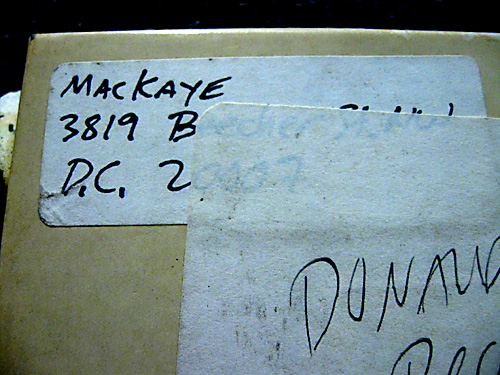
    In MacKaye’s hands is a cardboard box, the type made to hold reel-to-reel recording tape. The 7-inch-square container has been packed away among my possessions since 1981 or ’82, years when MacKaye was playing with Minor Threat and starting up Dischord Records, two of the most influential punk institutions of all time.

    His fingers slowly trace the words on the box. In the middle is a manual-typewriter-written Avery label. A handwritten return address sits in the upper-left corner. The addressee is “Mr. Walter Yetnikoff, CBS Records, 51 W. 52nd St. New York, N.Y. 10019.” The sender? “MacKaye, 3819 Beecher St. NW, DC 20007.”

    That latter address, of course, is for MacKaye’s boyhood home and the original Dischord headquarters. It still appears on the label’s records and Web site. Clearly, I had no idea of its significance at the time, or I wouldn’t have smacked a sticker of my own over part of it so cavalierly. In 1981, I had no idea who Ian MacKaye or Minor Threat was.

    So…this must be MacKaye’s box, right? But why would the fiercely independent MacKaye ever want to traffic with CBS Records? MacKaye denies having any knowledge of the answers to these questions: It’s not his handwriting, either, he says.

    But he thinks it might be his mother’s. Right now, he’s trying to describe it to her: “I’m looking at it and…there’s no ‘Washington,’ and the seven is hatched—it’s got a cross through it. I called [my sister] Katy, thought maybe she might have sent a tape—it might be a demo tape—to CBS Records. I was thinking, Maybe the Tom Ladamierszky tape? Is that possible? Does this sound at all vaguely familiar to you?”

    “Never?” MacKaye turns to me: “She never crosses her sevens. Wow. The mystery deepens.” He then promises to bring a copy of the box to his mom. “Maybe it will jog your memory,” he says into the phone. “It’s completely mysterious. The tape that’s in there is Dave’s tape. At some point he made a recording. The recording is a guy doing a Donald Duck impersonation.”

    Let’s stop here a moment. The recording currently inside the box is not in question. The “guy” doing the very convincing Donald Duck impression is local musician Jon Carroll, who was still a member of the Grammy-winning Starland Vocal Band when he deigned to lower his standards and record with my non-Grammy-winning comedy troupe, Travesty Ltd. The recording is a sketch called “Donald Dearest.” It’s a takeoff on the infamous Joan Crawford bio, wherein a young Huey Duck dishes the dirt on his unca’s dark side. Quite droll. Dr. Demento played it.
    mystery tape box

    The track was recorded for Travesty’s 1982 album, Teen Comedy Party, though infighting among us comic geniuses resulted in its being left off the record in favor of a cut not written by me. So the tape—and its box—went into storage.

    Two years ago, those members of Travesty still on speaking terms decided to re-release Teen Comedy Party on CD. In the search for “bonus” tracks to add to the digitized album, I went back to the dusty boxes in my archives. By this time, naturally, I was familiar with the MacKaye name.

    But I had no idea of how it came to be sharing a box with that of a creature such as Walter Yetnikoff, the hard-partying pal of Mick Jagger, Michael Jackson, Billy Joel, and so many more exemplars of mainstream pop. A self-described “shmoozer, shmingler, and bingler” who was also called a “high-handed vulgarian” by critic Robert Christgau, Yetnikoff enjoyed a career that would become emblematic of the excesses of the music industry throughout the ’70s and ’80s. You can read about it in Fredric Dannen‘s well-known 1990 book Hit Men: Power Brokers & Fast Money Inside the Music Business. Here, for example, is Yetnikoff recounting his first meeting with Cyndi Lauper: “I said, ‘Are you crazy? You’re out of your mind.’ I said, ‘You see over in the corner, a pile of hay and straw? Go sit on it, have your period, and come back when you’re finished!'” Charming man.

    After negotiating the disastrous sale of Columbia Pictures to Sony in 1989, Yetnikoff was shown the door. He hasn’t really been heard from since he sold his subsequent label, Velvel, to “major alternative” KOCH Entertainment in 1999.

    Did an angry young Ian, like many an ambitious lad before him, desire a record deal and decide to go right to the top? And did the fact that Yetnikoff was too busy with his many “shiksa mistresses” to appreciate the cultural import of a song such as “Bottled Violence” turn the plucky kid into a DIY Scarlett O’Hara, furiously shaking his fists at the sky and screaming, “As God is my witness, I’ll never sell out again!”?

    “Don’t put any speculation in there or I’ll be pissed,” MacKaye warns.

    The other members of Minor Threat also deny any knowledge of the box. Jeff Nelson, Dischord co-founder and Minor Threat drummer, offers only puzzlement. Brian Baker, who played bass and guitar in the band and is currently a member of Bad Religion, offers little more: “I didn’t send it,” he e-mails. “Try Lyle.” Guitarist Lyle Preslar never responds to queries—but nobody thinks he’s a likely suspect.

    “My younger brother and sister have been in bands,” MacKaye says, musing about who else might have written his surname on the box. “But anything they’ve recorded, I’ve been involved with. And they would certainly never send anything to CBS. My older sister never recorded music. I was the first one in the family to do that.

    “I know I’m the most likely candidate, because it goes with your weird concept,” MacKaye eventually concedes. Then he offers up a weird concept of his own: “Tom Ladamierszky was a Hungarian guy who lived on Beecher Street two doors up. And he was the lover of Mrs. Whitley. Mrs. Whitley was a widow, and then this guy Tom Ladamierszky moved in. They were in their 50s, 60s. Tom was a piano player and a member of ASCAP and very proud of it. Matter of fact, somewhere I have his ASCAP membership certificate framed.

    “And he was very old-school, a tunesmith guy. You’d hear him all summer tinkering away at the piano. But once I got involved in music, he was like, ‘Oh, you have to help me!’ ‘Cause he would send his songs off to people—but he couldn’t sell his songs. I think he sold one or two, maybe. But he was a pretty crazy guy. Definitely the neighborhood letch. Like, he would lay out naked on his front porch. Just a kook…

    “Anyway, he died. Probably 1984, ’85. But toward the end of his life he really became fixated on trying to get his songs sold and published. That’s why I thought it must be Tom Ladamierszky, because he’d always bring me cassettes and want me to ‘Put out these songs on your label.’ I couldn’t explain to him—at all—that this was just two different worlds.”

    We pause to consider the infinite cosmos. MacKaye looks down at the box again. “This is a really good mystery,” he says. “This is exactly the kind of thing I need in my life right now.”

    mystery tape box

    [NOTE: The typewritten label has faded since this article was first published in Washington City Paper. If you click the image above, you will see that I have added a typeset layer that aligns with the original text.]

    MacKaye decides to go across the street to the Dischord office. “[Ladamierszky] may well have supplied [my mother] with the tape, and she may have sent the letter,” he says as we get up. “I wish there was some other clue in there….My mom played piano, but nobody recorded music, ever. We never had a reel-to-reel tape deck that I recall. Actually, I do remember that we had one that my brother and I used to do pottery on. Because it would spin, y’know?

    “But I never came across such tape boxes until I was in the studio with Don [Zientara, who recorded Minor Threat]. That’s why I can’t imagine why my mom would have it. It’s totally bizarre. It’s completely bizarre. Well, let’s go copy it.”

    MacKaye runs off some copies of the top of the box.

    “That’s my mother’s handwriting,” he announces after a few minutes. “I’m sure of it now.” Then he eyes the unpostmarked box again: “It wasn’t mailed. That’s the thing that’s weird.”

    Maybe it was mailed in another envelope?

    “But why would Walter Yetnikoff send it back down?”

    Dead end apparently reached, MacKaye mentions that he’s leaving for a Fugazi tour of Europe and promises to get back in touch after he returns.

    When we finally hook up again, he has changed his mind about blaming his mother: “My mom looked at it and said it’s not her. She’s completely baffled by it….My mom just kept saying, ‘Well, how did he get it?'”

    The short answer is I don’t know. I might have picked it up from the studio where we recorded “Donald Dearest,” a Rosslyn postproduction house called Musifex. Our producer and engineer, Rich West, was a partner in the firm, so we could sneak in nights and weekends and make duck noises into some pretty expensive microphones. Good times.

    West, however, swears that he has no recollection of any young kid named Ian hanging around or recording any demo tapes. “No. To my knowledge, no,” he says without hesitation. “That’s not something that ever happened.”

    And because Musifex was not a music-recording studio, there would be no reason for Minor Threat to work there. But for a handful of exceptions, MacKaye did all his work at Inner Ear with Zientara.

    Another plausible explanation is that the box came from the Earle Palmer Brown advertising agency in Bethesda, where I worked in the early ’80s. Like most ad agencies, EPB championed throwaway culture, and the media department would regularly toss out the many audition tapes, focus-group recordings, and old jingles that accumulated. Being a cheap scrounge, I would collect them from the trash and reuse them.

    MacKaye draws a blank at the mention of EPB, as does his mother: “We don’t know anybody in advertising at all,” he says, rather surprised at the very notion.

    I haven’t kept in touch with most of the folks from EPB since I slammed my hand on the boss’s desk and shouted, “Fuck you! I quit!” And Earle Palmer Brown went out of business in October 2002. But I do manage to locate Jill Flax, who worked in the media department with me, to ask her about the MacKaye box.

    “It doesn’t ring any kind of bells,” she says.

    Back in MacKaye’s living room, the questions are going around in circles and the answers seem farther away. After a while, MacKaye looks for closure.

    “I would say [Ladamierszky] is definitely the most plausible,” he says. “It just never occurred to us to send [Minor Threat’s music] to anybody for any reason. We were never thinking in terms of making it at all….I’ve never thought of being signed. It just never occurred to me. Ever. So I would never send a tape to Yetnikoff.”

    After a moment, MacKaye adds softly, “Tom Ladamierszky, bless his heart, rest in peace, it must be on him.”

    I point out that blaming it on the dead guy is the most convenient solution. Of course, in this case it’s also the only explanation that comes close to making any sense. And it’s comforting to continue believing that MacKaye was never eager to be co-opted by a major label. But he rejects my notion of selling out.

    “Sending a tape does not mean selling out,” he argues. “People send me tapes, it doesn’t mean they’re selling out. The idea is, you’ve made the music, now what? Which is how Tom Ladamierszky was. He wrote songs. And he didn’t know what to do with them. He had no idea. But he had music inside of him that was coming out. So he joined ASCAP. He tried to do it proper.”

    “But there’s a lesson here,” MacKaye adds with a grin. “The proper way is not usually the most effective one.”