Mellow Christian Disco Country — I’ll Play Anything

Hal Blaine has always been an inspiration to me. He calls himself the most recorded drummer of all time, and the evidence seems to support him. And his quality matches his quantity. In addition to pounding the definitive Phil Spector beat on “Be My Baby,” the skins man provided precise stick- and footwork on “Return to Sender,” “Good Vibrations,” and even Dino’s “Everybody Loves Somebody,” as well as hundreds of chart-toppers through the late ’70s.

All of which is to say I’m no Hal Blaine. But these tracks display a certain versatility, if nothing else. First up is a disco song. I think disco was already dead when we recorded this at Omega Studios in Kensington. I am unashamed to say that the beat is fun to play and if asked, I would play it again. So there.

“Another Eight Hours”

My only entry into the world of Christian Rock came via an intense young man named David Coggeshall. Producer Caltrick Simone (ne Stein) was unafraid to put his money into a work of unabashed Godliness. And, miracle of miracles, the tune was pick-hit-of-the-week on WINX-AM radio in Rockville. (Or WPGC. I’ll fact-check this later.) Not sure what happened to Mr. Coggeshall. Hope he’s not in Hell.

“Give Your Life to Him”

I remember this session, but not the names of anybody involved. It was the ’70s, make your own joke. I recall that a couple Georgetown or GW students, or grad students, had a bunch of songs they wanted recorded and I got the call. One guy’s tunes were wacky folky things that he presented with more enthusiasm than authority. But the other guy was more serious and his song has an Andy Williams vibe that I kinda dig. If Andy Williams has any vibe.

“Carrie’s Plane Is Leaving”

Another Dan Pasley session. I think this was supposed to be part of a musical, or something. Dan’s commercial work was always trying to be theatrical, and his theatrical work hoped to be commercial. Recorded this in the basement of a tract house in PG County. Again, can’t recall the singer, a spunky little gal with a big voice.

“Nashville Women”


A sports writer, TV writer, music writer, and a drummer walk into a recording studio. Here’s music recorded in this century, recorded at the fabtabulous Scary Clown Studios, in fact, by the equally splenderiffic Philip Stevenson.

The first session, we got right down to recording the theme song for the music writer’s radio show. Which had been canceled some weeks previous. Still, there was a need for closure. I’m sure the three people who listened to the program are retroactively delighted to finally have a tune to hum along to while not waiting to dial in.

“The Theme From the (Canceled) Music Show”


The second tune was inspired by an interview with Don Kirshner, he of the fabled ABC show In Concert, the show that introduced Alice Cooper to much of America. Don also introduced us to the music of the Monkees, a fact the Monkees themselves are still not too happy about.

Anyway, we did the song, then stuck in real and imagined quotes from the interview. It’s not Don, of course, saying these things. But it’s certainly the spirit of Don. And the spirit of Don is what’s kept this country free.

“Plump Little Fingers, “The Chocolate Thing”

The Soundtrack Remains the Same

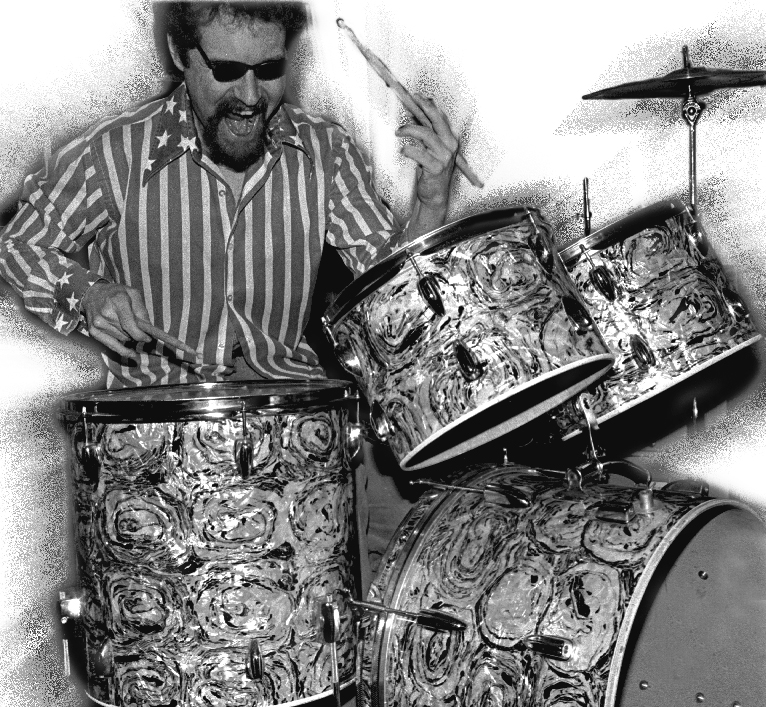
Ludwig Super Classic at Track Studios

While I wait for Danny Elfman or Hans Zimmer to call, here’s some music I recorded for a couple of industrial films.

Until the early ’80s, Washington, D.C., was a hotbed of taxpayer-supported documentaries, training films, and informational filmmaking. Almost none of it was necessary. Like everyone else, I was happy to take the cash.

Tragically, I never got a copy of any of the tunes from my greatest session, a song cycle for the film School Bus Safety and You. I did keep the sheet music, and the lyrics stick with me these many decades later:

Be at your bus stop on time
Always wait by the yellow line
Be careful, courteous, and kind
And ride the bus that your assigned

If you can imagine the cloying sing-songiness, you are only halfway to imagining the extremely cloying sing-songiness. Barney would be proud.

Anyway, the first tune is from a film created to explain the wacky new “European-style” road signs that the government was forcing on unsuspecting Americans. You know, the red circle-and-slash? Whose meaning is pretty close to obvious. Yes, there was a time when the U.S. didn’t take its marching orders — and don’t-walk orders — from France. Of the dozen or so cuts, I think this track states the theme nicely, don’t you?

The European Way…

UPDATE: After listening to this again, I do believe that Tommy Hannum is playing the pedal steel on the track. Tommy’s big in Nashville these days, but back then he was a member of the Rosslyn Mountain Boys.

The 1970s were dangerous time. For one thing, Al Gore was preoccupied with courting Tipper, leaving the country in the grip of the greatest menace since fluoridation. From the stirring documentary Drinking Water Alert, this song helped win the Vietnam war.

Watch what you drink…

Jingly Jangly Jingles

dave oyster drums

I write elsewhere about the death of the jingle, and these samples may better explain why it died.

You cannot have listened to the radio in the past, oh, 30 years, and not heard this ditty. Me, bass player Gary Fallwell, and guitar player Chopper spent a whole day at Track Studios in Silver Spring jamming around on various ideas before settling on four notes in a descending pattern repeated over and over. And over. Horns and vocals were added sometime later. Got $25 for the effort. If I’d asked for a five-cent royalty, I’d be rich today. Not a week went by without the Jerry’s Ford jingle playing somewhere. It was syndicated, so I even heard late one night it as I drove into Dallas.

In fact, the jingle was played so much that the master tape wore out. They re-did it with synthesizers some time in the early 2000s. When I heard the new version, I called Jerry himself, looking to get in touch with the original producer, whose name has escaped me. I was going to write an article. When I mentioned that, Jerry got real squirrely and defensive.

“Jerry’s Ford jingle”

I do know the producer’s name for these Blank Pontiac spots: Dan Pasley. Most of my commercial recording work was with Dan, and it was (almost) always a pleasure. Mostly because Dan ran a, shall we say, loose session. Often he’d show up, late, open his briefcase, pull out a bottle, and declare, “Let’s get started.” It was then apparent that whatever we would be recording would be made up on the spot between now and whenever everyone passed out. Good times.

In this session, we cut a bunch of variations on the theme, for the different radio stations. Here’s the WGAY, i.e., white people, version. And this is the WOL downtown black people version. Same damn Pontiacs, of course.

“Blank Pontiac “Wide Tracking” (Smooth)”

“Blank Pontiac “Wide Tracking” (Funky)”

Did a whole bunch of work for the Britches of Georgetown organization thanks to Dan. This is one of my faves, for the chain’s country branch. The Eagles were popular at the time. Guess they still are.

“Britches Western”

The Last Chanteuse

written by dave nuttycombe for the washington post

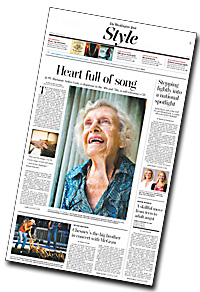
Had the delight to interview Marianne Arden Cook for the Washington Post. Marianne is 99-years-young, as they say, and with her it’s true. I could hardly keep her hands off me! (Not really lying.)

The occasion was because the one-time traveling chanteuse is putting out an album of her original songs. She’s written 130, she says. She sang some for me.

Here is the link to the article.

An added delight on this assignment was that the photos were taken by my dear old friend Bill O’Leary. A gallery of his images is here.

Also cool is that I shared the page with Molly Ringwald! Well, a review of her new novel. Which is apparently quite good. Yay for Molly! I’m gonna buy it.

I sent the Post some MP3s of Marianne’s tunes, which they chose not to run, for some reason. So I will include one here. Maybe my favorite, “I Remember (Boom Boom).” It’s so very of its time and place and I find it rather haunting. Enjoy.

Rock & Roll Will Never Die — If The Fabulous Hubcaps Have Anything To Say About It.

hubcaps washington post

My piece on the Fabulous Hubcaps takes over most of the front page of the Washington Post Style section today. The assignment called for 1,200 words. I wound up with nearly 13,000 transcribed words. So I think I undersold the piece. Coulda been a magazine feature, ’cause there was sooo much fascinating, fun, and relevant info that did not make the cut. I will say that I’m glad to be able to use the serial comma again. Also, when will publications stop putting a K in the abbreviation of microphone? It’s mic, not mike. Mike is a person.

But these are personal peeves and not aimed at any of the fine staffers and friends at the Post. Go, newspapers!

Come On, Get Happy

Ken and Jeannie Veltz and their children were a real-life Partridge Family. After the band broke up, Mom and Dad hit the road alone, trying to keep the music alive.

written by dave nuttycombe for the washington post

[NOTE: A truncated version of this piece ran in the Washington Post, which you may read here. That piece excised two-thirds of the story to focus on the parents. While their journey was certainly the hook, this longer version provides much deeper history, context, and insight, as well as a closer look into the curious machinations of the so-called music business. I had, after all, spent a decade following the story; there was lots to say. Also, I’ve changed the diminutive of microphone back to “mic” from “mike.” There is no K in microphone.]

KEN AND JEANNIE VELTZ ARE DRIVING to an open-mic in Old Town. The couple mapped several such spots into the GPS for this Thursday night. A guitar rides shotgun in the back seat; the trunk is filled with sound and music equipment. The duo are scheduled to perform at Iota on Sunday and, as Ken says, “You can’t roll around with the grandbabies all day.” Playing live will limber the pair up, get them ready for the paying gig.

Unlike most of the plaintive singers on the D.C. open-mic circuit, Ken and Jeannie are in fact grandparents, twice over. Also separating them from the usual six-string strummers: they have a Wikipedia page. As the band Cecilia, the Veltzes were signed to Atlantic Records. It wasn’t just the two, it was the entire family: son Drew on lead guitar, daughters Laura and Allison singing, dad on rhythm guitar and percussion, mom completing the three-part harmonies and shaking the tambourine.

Yes, just like the Partridge Family. But real and with much better music.

And a bus, of course. It didn’t have a multi-colored Mondrian paint job, but the family did tour nationally for most of the previous decade. They were courted by MTV and Hollywood film crews, wined and dined and lived as much of the rock star life as a fairly well-adjusted musical family cared to live.

Before the label deal, when the Veltzes were just a family band from Vienna, Va., this is what The Washington Post had to say about Cecilia in 1999:

“If you care at all for melody, harmony and good songs, you must go see Cecilia. If you want to let music do what it’s supposed to do (fill your heart and soul and make you glad to be alive), you must go see Cecilia.

The family seemed poised to climb to the top of the Top 40. But, like thousands before them, the Veltzes discovered that a set full of catchy tunes and club full of eager fans is not always enough. Unlike thousands before them, Ken and Jeannie refuse to let rejection define them. Even faced with a failing economy, the aging Boomers are betting everything on one more grab at the brass ring. The couple has 37 years together singing happy, upbeat songs

They’re Playing Our Song (to Death)

Who Killed the Jingle? How a Unique American Art Form Disappeared

By Steve Karmen

Hal Leonard, 184 pp., $22.95

STEVE KARMEN’S TITLE ASKS A FAIR QUESTION: How did the once ubiquitous advertising jingle come to die? And, as the People-proclaimed “King of the Jingle,” he brings an informed perspective to the quest for an answer. Now retired, Karmen is fiercely proud to be responsible for such instantly recognizable tunes as “I Love New York,” “This Bud’s for You,” “Nationwide Is on Your Side,” and many dozens more pieces of musical Americana. If he doesn’t name a particular murderous “who,” his book is yet another chapter in the “why everything is going wrong” casebook.

Though many occupations and products have disappeared because of technology, we can’t blame the Internet or digitalization for the loss of “Oh-oh, Spaghetti-Os.” The real culprit in the case of the vanishing jingle and its replacement with rearranged or simply appropriated popular music is that, as one composer told Karmen, “No one thinks anymore. Imitation is the sincerest form of not having an original idea.” And no one wants to stick his neck out.

Underpinning the unoriginality, of course, is fear. Karmen spoke with many people in the biz for his book, and nearly everyone reflexively declined to speak on the record, no matter how inoffensive the quote. Fear grips ad people from inside and out, because they’re at the mercy of forces they can’t control: Advertising is neither art nor science, though it pretends to both. Despite the fact that Ridley Scott directed it, that 30-second minimovie fails as art because the product is always the star. And if you want to talk market research, I have two words for you: New Coke.

Coca-Cola’s CEO in 1984, Roberto Goizueta

Tiki Tiki Boom Boom

It Don’t Mean a Thing If It Ain’t Got That Boink

Space Age Bachelor Pad Music
Esquivel!
Bar None

In considering the work of Mexican arranger/composer/bandleader Juan Garcia Esquivel, one is reminded of the words of Edd “Kookie” Burns, who said it best when he remarked: “Wowsville, daddy-o!”

Simplemente Esquivel

Of course, he was speaking in an entirely different context, but the sentiment remains apt. The 14 tracks on Space Age Bachelor Pad Music, a reissue of some of Esquivel’s most distinctive recordings, are stubbornly resistant to categorization. Even Esquivel has trouble describing Esquivel! music; one of his three originals is titled “Whatchamacallit.”

It is appropriate during this so-called “easy listening revival” that Esquivel’s genius should be finally recognized. While such trend-spotters as Newsweek have proclaimed that a “cocktail nation” is bubbling away among disaffected grungers, most of the bands comprising it seem to be under the misapprehension that merely donning evening dress and turning down the amps is all that’s required to be considered a happening sophisticate. Even a cursory listen to Bachelor Pad should reveal that being “easy” isn’t that easy.

A contemporary of that avatar of exotica, Martin Denny (whose 1957 hit, “Quiet Village,” with its human-produced jungle animal noises and Polynesian instrumentation, began the craze for hypnotic “tiki” sounds), Esquivel released a series of instrumental albums beginning in 1957 and continuing through 1968. While this era coincides with rock ‘n’ roll’s wildest pre-teen years, you wouldn’t know it from listening to this record.

Most of the songs on Bachelor Pad were familiar middle-of-the-road standards long before Esquivel got to them. His versions, however, are at once familiar and utterly foreign. In Esquivel’s hands, “Harlem Nocturne” sounds as if the arranger took the A train uptown via Saturn

The Tale of the Tape Box

Does the writing on a decades-old reel-to-reel container spell the end for Ian MacKaye’s reputation?

dischord mystery tape

Ian MacKaye is on the phone with his mother. His reputation is also on the line. I have come to his Arlington home to confront the well-known indie avatar about his past.

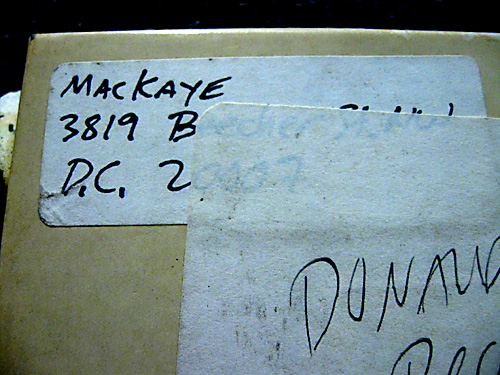
In MacKaye’s hands is a cardboard box, the type made to hold reel-to-reel recording tape. The 7-inch-square container has been packed away among my possessions since 1981 or ’82, years when MacKaye was playing with Minor Threat and starting up Dischord Records, two of the most influential punk institutions of all time.

His fingers slowly trace the words on the box. In the middle is a manual-typewriter-written Avery label. A handwritten return address sits in the upper-left corner. The addressee is “Mr. Walter Yetnikoff, CBS Records, 51 W. 52nd St. New York, N.Y. 10019.” The sender? “MacKaye, 3819 Beecher St. NW, DC 20007.”

That latter address, of course, is for MacKaye’s boyhood home and the original Dischord headquarters. It still appears on the label’s records and Web site. Clearly, I had no idea of its significance at the time, or I wouldn’t have smacked a sticker of my own over part of it so cavalierly. In 1981, I had no idea who Ian MacKaye or Minor Threat was.

So…this must be MacKaye’s box, right? But why would the fiercely independent MacKaye ever want to traffic with CBS Records? MacKaye denies having any knowledge of the answers to these questions: It’s not his handwriting, either, he says.

But he thinks it might be his mother’s. Right now, he’s trying to describe it to her: “I’m looking at it and…there’s no ‘Washington,’ and the seven is hatched—it’s got a cross through it. I called [my sister] Katy, thought maybe she might have sent a tape—it might be a demo tape—to CBS Records. I was thinking, Maybe the Tom Ladamierszky tape? Is that possible? Does this sound at all vaguely familiar to you?”

“Never?” MacKaye turns to me: “She never crosses her sevens. Wow. The mystery deepens.” He then promises to bring a copy of the box to his mom. “Maybe it will jog your memory,” he says into the phone. “It’s completely mysterious. The tape that’s in there is Dave’s tape. At some point he made a recording. The recording is a guy doing a Donald Duck impersonation.”

Let’s stop here a moment. The recording currently inside the box is not in question. The “guy” doing the very convincing Donald Duck impression is local musician Jon Carroll, who was still a member of the Grammy-winning Starland Vocal Band when he deigned to lower his standards and record with my non-Grammy-winning comedy troupe, Travesty Ltd. The recording is a sketch called “Donald Dearest.” It’s a takeoff on the infamous Joan Crawford bio, wherein a young Huey Duck dishes the dirt on his unca’s dark side. Quite droll. Dr. Demento played it.
mystery tape box

The track was recorded for Travesty’s 1982 album, Teen Comedy Party, though infighting among us comic geniuses resulted in its being left off the record in favor of a cut not written by me. So the tape—and its box—went into storage.

Two years ago, those members of Travesty still on speaking terms decided to re-release Teen Comedy Party on CD. In the search for “bonus” tracks to add to the digitized album, I went back to the dusty boxes in my archives. By this time, naturally, I was familiar with the MacKaye name.

But I had no idea of how it came to be sharing a box with that of a creature such as Walter Yetnikoff, the hard-partying pal of Mick Jagger, Michael Jackson, Billy Joel, and so many more exemplars of mainstream pop. A self-described “shmoozer, shmingler, and bingler” who was also called a “high-handed vulgarian” by critic Robert Christgau, Yetnikoff enjoyed a career that would become emblematic of the excesses of the music industry throughout the ’70s and ’80s. You can read about it in Fredric Dannen‘s well-known 1990 book Hit Men: Power Brokers & Fast Money Inside the Music Business. Here, for example, is Yetnikoff recounting his first meeting with Cyndi Lauper: “I said, ‘Are you crazy? You’re out of your mind.’ I said, ‘You see over in the corner, a pile of hay and straw? Go sit on it, have your period, and come back when you’re finished!'” Charming man.

After negotiating the disastrous sale of Columbia Pictures to Sony in 1989, Yetnikoff was shown the door. He hasn’t really been heard from since he sold his subsequent label, Velvel, to “major alternative” KOCH Entertainment in 1999.

Did an angry young Ian, like many an ambitious lad before him, desire a record deal and decide to go right to the top? And did the fact that Yetnikoff was too busy with his many “shiksa mistresses” to appreciate the cultural import of a song such as “Bottled Violence” turn the plucky kid into a DIY Scarlett O’Hara, furiously shaking his fists at the sky and screaming, “As God is my witness, I’ll never sell out again!”?

“Don’t put any speculation in there or I’ll be pissed,” MacKaye warns.

The other members of Minor Threat also deny any knowledge of the box. Jeff Nelson, Dischord co-founder and Minor Threat drummer, offers only puzzlement. Brian Baker, who played bass and guitar in the band and is currently a member of Bad Religion, offers little more: “I didn’t send it,” he e-mails. “Try Lyle.” Guitarist Lyle Preslar never responds to queries—but nobody thinks he’s a likely suspect.

“My younger brother and sister have been in bands,” MacKaye says, musing about who else might have written his surname on the box. “But anything they’ve recorded, I’ve been involved with. And they would certainly never send anything to CBS. My older sister never recorded music. I was the first one in the family to do that.

“I know I’m the most likely candidate, because it goes with your weird concept,” MacKaye eventually concedes. Then he offers up a weird concept of his own: “Tom Ladamierszky was a Hungarian guy who lived on Beecher Street two doors up. And he was the lover of Mrs. Whitley. Mrs. Whitley was a widow, and then this guy Tom Ladamierszky moved in. They were in their 50s, 60s. Tom was a piano player and a member of ASCAP and very proud of it. Matter of fact, somewhere I have his ASCAP membership certificate framed.

“And he was very old-school, a tunesmith guy. You’d hear him all summer tinkering away at the piano. But once I got involved in music, he was like, ‘Oh, you have to help me!’ ‘Cause he would send his songs off to people—but he couldn’t sell his songs. I think he sold one or two, maybe. But he was a pretty crazy guy. Definitely the neighborhood letch. Like, he would lay out naked on his front porch. Just a kook…

“Anyway, he died. Probably 1984, ’85. But toward the end of his life he really became fixated on trying to get his songs sold and published. That’s why I thought it must be Tom Ladamierszky, because he’d always bring me cassettes and want me to ‘Put out these songs on your label.’ I couldn’t explain to him—at all—that this was just two different worlds.”

We pause to consider the infinite cosmos. MacKaye looks down at the box again. “This is a really good mystery,” he says. “This is exactly the kind of thing I need in my life right now.”

mystery tape box

[NOTE: The typewritten label has faded since this article was first published in Washington City Paper. If you click the image above, you will see that I have added a typeset layer that aligns with the original text.]

MacKaye decides to go across the street to the Dischord office. “[Ladamierszky] may well have supplied [my mother] with the tape, and she may have sent the letter,” he says as we get up. “I wish there was some other clue in there….My mom played piano, but nobody recorded music, ever. We never had a reel-to-reel tape deck that I recall. Actually, I do remember that we had one that my brother and I used to do pottery on. Because it would spin, y’know?

“But I never came across such tape boxes until I was in the studio with Don [Zientara, who recorded Minor Threat]. That’s why I can’t imagine why my mom would have it. It’s totally bizarre. It’s completely bizarre. Well, let’s go copy it.”

MacKaye runs off some copies of the top of the box.

“That’s my mother’s handwriting,” he announces after a few minutes. “I’m sure of it now.” Then he eyes the unpostmarked box again: “It wasn’t mailed. That’s the thing that’s weird.”

Maybe it was mailed in another envelope?

“But why would Walter Yetnikoff send it back down?”

Dead end apparently reached, MacKaye mentions that he’s leaving for a Fugazi tour of Europe and promises to get back in touch after he returns.

When we finally hook up again, he has changed his mind about blaming his mother: “My mom looked at it and said it’s not her. She’s completely baffled by it….My mom just kept saying, ‘Well, how did he get it?'”

The short answer is I don’t know. I might have picked it up from the studio where we recorded “Donald Dearest,” a Rosslyn postproduction house called Musifex. Our producer and engineer, Rich West, was a partner in the firm, so we could sneak in nights and weekends and make duck noises into some pretty expensive microphones. Good times.

West, however, swears that he has no recollection of any young kid named Ian hanging around or recording any demo tapes. “No. To my knowledge, no,” he says without hesitation. “That’s not something that ever happened.”

And because Musifex was not a music-recording studio, there would be no reason for Minor Threat to work there. But for a handful of exceptions, MacKaye did all his work at Inner Ear with Zientara.

Another plausible explanation is that the box came from the Earle Palmer Brown advertising agency in Bethesda, where I worked in the early ’80s. Like most ad agencies, EPB championed throwaway culture, and the media department would regularly toss out the many audition tapes, focus-group recordings, and old jingles that accumulated. Being a cheap scrounge, I would collect them from the trash and reuse them.

MacKaye draws a blank at the mention of EPB, as does his mother: “We don’t know anybody in advertising at all,” he says, rather surprised at the very notion.

I haven’t kept in touch with most of the folks from EPB since I slammed my hand on the boss’s desk and shouted, “Fuck you! I quit!” And Earle Palmer Brown went out of business in October 2002. But I do manage to locate Jill Flax, who worked in the media department with me, to ask her about the MacKaye box.

“It doesn’t ring any kind of bells,” she says.

Back in MacKaye’s living room, the questions are going around in circles and the answers seem farther away. After a while, MacKaye looks for closure.

“I would say [Ladamierszky] is definitely the most plausible,” he says. “It just never occurred to us to send [Minor Threat’s music] to anybody for any reason. We were never thinking in terms of making it at all….I’ve never thought of being signed. It just never occurred to me. Ever. So I would never send a tape to Yetnikoff.”

After a moment, MacKaye adds softly, “Tom Ladamierszky, bless his heart, rest in peace, it must be on him.”

I point out that blaming it on the dead guy is the most convenient solution. Of course, in this case it’s also the only explanation that comes close to making any sense. And it’s comforting to continue believing that MacKaye was never eager to be co-opted by a major label. But he rejects my notion of selling out.

“Sending a tape does not mean selling out,” he argues. “People send me tapes, it doesn’t mean they’re selling out. The idea is, you’ve made the music, now what? Which is how Tom Ladamierszky was. He wrote songs. And he didn’t know what to do with them. He had no idea. But he had music inside of him that was coming out. So he joined ASCAP. He tried to do it proper.”

“But there’s a lesson here,” MacKaye adds with a grin. “The proper way is not usually the most effective one.”